

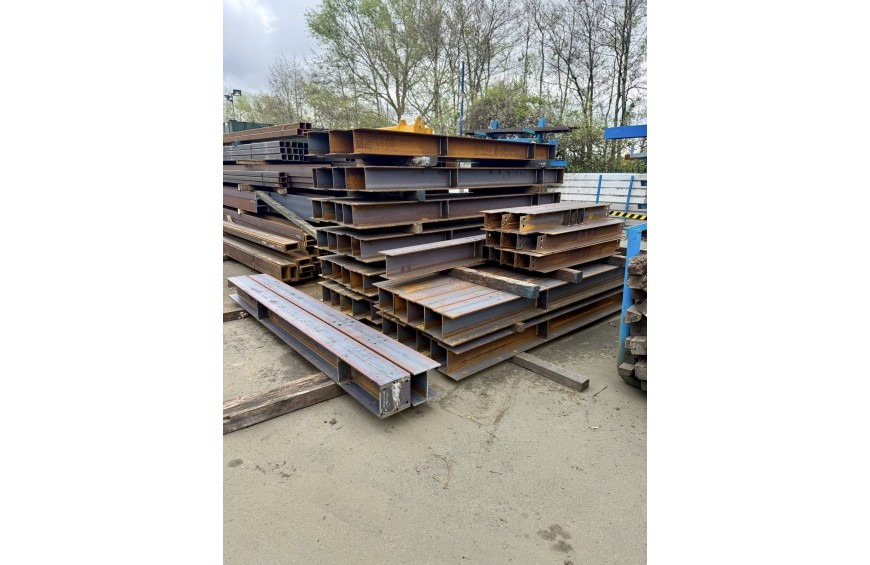
When you order structural steel, the question of surface treatment tends to come up fairly late — after the section size has been agreed, after the length has been confirmed, almost as an afterthought. That's understandable. The structural decisions feel like the important ones, and surface treatment can seem like finishing work.
It isn't. The wrong choice between galvanised and primed steel is the kind of decision that costs nothing to get right and a significant amount to correct. Once steel is installed, changing the surface treatment means either living with whatever corrosion develops or taking the structure apart. Neither is a good option.
The choice between galvanisation and priming isn't complicated once you understand what each treatment is actually doing, where each one is appropriate, and what the trade-offs genuinely are. This is that explanation.
What Primed Steel Actually Is
A primer is a preparatory coating applied to bare steel before it leaves the fabricator or stockholder. Its job is to provide short-term protection against corrosion during handling, transport, storage, and the construction phase — and to act as a bonding layer for whatever topcoat system is applied later.
The standard red oxide primer that most people in construction will recognise is an oil-based alkyd coating, typically applied at 50–75 microns dry film thickness. It does a reasonable job of protecting steel during the period between fabrication and final painting, but it is not a standalone long-term corrosion protection system. It's a start, not a finish.
Other primer types are available — zinc phosphate primers, epoxy primers, zinc-rich primers — each offering different performance characteristics and compatibility with different topcoat systems. For most domestic and light commercial structural steel applications, the standard red oxide is what you'll receive unless you specify otherwise.
The important thing to understand about primed steel is that it is expected to receive further treatment. When it arrives on site with a primer coat, the assumption built into that product is that someone is going to paint over it. If they don't — if a primed beam is installed in a location where paint can't be applied or won't be maintained — the primer will eventually fail and corrosion will follow.
What Galvanisation Actually Is
Hot-dip galvanisation is a fundamentally different process. The steel section is submerged in a bath of molten zinc at around 450°C. The zinc reacts metallurgically with the steel surface, forming a series of zinc-iron alloy layers topped with a layer of pure zinc. The result is a coating that is bonded to the steel at a molecular level, not simply sitting on top of it.
This matters in two ways. First, the coating is mechanically tough — it resists damage from handling and abrasion in ways that paint-based systems don't. Second, and more importantly, zinc provides cathodic protection to the steel beneath it. Even where the coating is damaged and bare steel is exposed, the zinc corrodes preferentially, sacrificing itself to protect the steel around the breach. A scratch through a galvanised coating doesn't immediately lead to rust spreading under the surface the way it can with paint.
The typical coating thickness achieved by hot-dip galvanisation is 45–85 microns on structural sections, significantly thicker than most primer coats and substantially more durable in demanding environments.
The trade-off is cost, lead time, and dimensional change. Galvanising a structural section costs more than priming it. It requires transportation to a galvanising plant, which adds time. And the process adds a small but measurable amount of material to the surface — relevant where tight tolerances are required, and occasionally problematic if the section needs to pass through a tight opening or mate with a pre-drilled connection that doesn't account for the additional thickness.
There are also certain steel compositions that galvanise less predictably, and sections with enclosed voids require venting holes to allow safe immersion in the zinc bath. These aren't usually problems for standard structural sections, but they're worth knowing about.
The Application Question: Where Will This Steel Be?
The single most important factor in choosing between galvanised and primed steel is the environment the steel will sit in. Everything else — cost, aesthetics, lead time — is secondary to getting this right.
Fully Internal, Dry Environments
A steel beam installed inside a building, enclosed within a ceiling or floor build-up, and not exposed to moisture, condensation, or humidity above normal indoor levels is in a low-risk environment. In these conditions, primed steel with a topcoat system applied before enclosure is generally adequate for the building's lifetime.
Many structural beams in domestic extensions, loft conversions, and internal openings sit exactly in this category. They're in a controlled environment, painted once during construction, and never exposed to anything that would challenge a good paint system. Galvanising in this context is technically superior but not meaningfully necessary — the improvement in longevity over a well-applied paint system in a dry interior isn't worth the additional cost for most applications.
Internal but Exposed or Humid
A steel beam that will remain visible — in an industrial-aesthetic interior, an exposed ceiling, a basement — or that sits in a humid environment such as a swimming pool enclosure, a commercial kitchen, or a building that has a history of condensation is a different case. Here, the maintenance question becomes important. Paint systems on internal steelwork do get damaged, and they don't always get repaired promptly. Galvanising provides a more forgiving base layer that tolerates neglect better than primer alone.
For exposed steelwork in humid internal environments, galvanising followed by a powder coat or compatible paint system is a well-established approach that offers both aesthetic control and genuine corrosion resistance.
External and Sheltered
Steelwork used in external applications — structural elements within open-sided canopies, pergolas, agricultural buildings, covered walkways — faces intermittent moisture exposure and temperature cycling. A paint system will require maintenance on a realistic timescale. Hot-dip galvanising provides substantially better durability without regular repainting, and in most external sheltered applications it represents the better whole-life cost even at higher initial cost.
External and Fully Exposed
For steelwork in direct weather exposure — gate posts, railings, external staircases, structural elements within open agricultural or industrial buildings — galvanising is effectively the baseline specification. A primer and paint system in this environment will begin failing within a few years without regular maintenance, particularly at cut ends, weld areas, and bolt holes where coating integrity is hardest to maintain.
The duplex system — hot-dip galvanising followed by painting — is the preferred approach where both long-term corrosion resistance and appearance control are important. The galvanising handles the corrosion protection; the paint handles aesthetics and provides an additional barrier layer. Studies on duplex systems consistently show that the combined service life is greater than the sum of either system alone, because each protects the other from its respective failure mode.
Buried or Embedded Steel
Any steel that will be embedded in concrete, partially buried, or in contact with masonry requires separate consideration. Hot-dip galvanising is generally appropriate for steel that will be in intermittent contact with moisture-laden masonry. For steel in direct contact with wet concrete during the curing phase, advice varies — zinc can react with alkalis in fresh concrete and the relationship between galvanised steel and reinforced concrete requires specific assessment. This is an area where confirming the specification with the structural engineer before ordering is worthwhile.
The Longevity and Cost Calculation
The framing of galvanised versus primed as a cost question only makes sense when you consider the full service life, not just the procurement cost.
Primed steel for a typical domestic beam might cost 10–20% less than the same section hot-dip galvanised, depending on the section size and the galvanising plant's minimum charges. That saving is real. The question is what it buys.
In a dry interior application with a good topcoat, it buys very little risk — the saving is genuine and the outcome is equivalent. In an external application, it buys a few hundred pounds now against the realistic prospect of remedial work in five to ten years: repainting at height, or investigating and treating early-stage corrosion at connection points before it becomes a structural concern.
Whole-life cost analysis consistently favours galvanising for external and semi-exposed applications, often by a significant margin once maintenance costs are included. The calculation depends on access (repainting steelwork at height or in awkward positions is expensive), the criticality of the element (a corroding structural beam is a more serious problem than a corroding handrail), and the realistic likelihood that maintenance will actually happen on schedule.
For domestic clients in particular, the honest answer is that paint maintenance rarely happens on schedule. A galvanised section that will outlast the building without attention is a more reliable outcome than a primed section that requires repainting every seven years and probably won't get it.
Cut Ends, Site Modifications, and the Coating Integrity Problem
One practical issue that often gets overlooked: whatever coating leaves the fabricator, the coating integrity at cut ends and site-drilled holes is the responsibility of whoever is doing that work on site.
A hot-dip galvanised beam cut to length on site exposes bare steel at the cut end. That end needs to be treated — cold-applied zinc-rich paint is the standard approach — before the section is installed. Leaving it bare negates the protection at the most vulnerable point of the section.
The same applies to primer: a drilled hole or a grinding mark that breaks through to bare steel needs touching in before the beam is painted or enclosed. It sounds obvious, but it's the kind of thing that gets overlooked when a team is working quickly.
The quality of the final corrosion protection system isn't just about what the steel was ordered with. It's about what condition that coating is in when the beam is finally enclosed or left in service.
Pratley's Builders Beams supplies structural steel sections in both primed and galvanised finishes. If you're not sure which treatment is right for your application, our team is happy to advise.

Submit comment Cancel Reply