

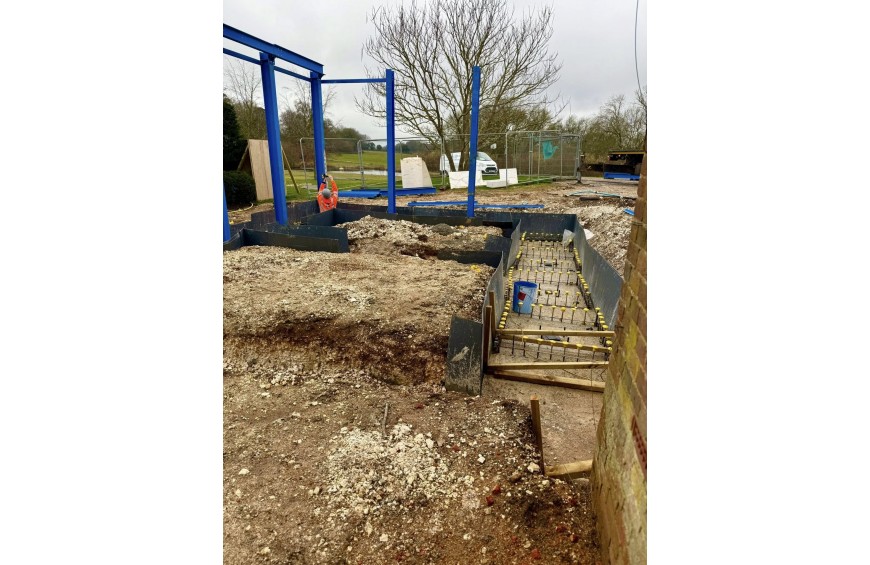
When a structural engineer signs off on a steel beam installation, they're thinking about load paths. Where does the weight travel? How does it get from the roof, through the walls, and safely down into the foundations? Most people asking for a steel beam — whether it's to open up a kitchen, form a new structural opening, or carry a floor above — understand that the beam itself does the heavy lifting. What far fewer people realise is that the beam can only do its job if something solid is sitting beneath each end of it.
That something is the padstone.
Padstones are one of the most consistently overlooked elements of a steel beam installation. They're not glamorous. They don't appear in the headline quote. But get them wrong — or miss them out entirely — and you've created a structural problem that no engineer would sign off on, and that time will make worse.
What a Padstone Actually Does
To understand why padstones matter, you need to think about concentration.
A steel beam carries load across a span, which sounds straightforward enough. But at each end, all of that load — the full weight the beam is supporting — gets transferred into a relatively small bearing point. The steel sits on the wall, and the wall has to accept that force.
Here's the problem. Brickwork and blockwork are good at carrying distributed load — weight spread evenly across a wide area. What they're not good at is concentrated point loads. When a steel beam bears directly onto a single brick or block, the localised stress can be many times higher than the material is designed to handle. The result? Crushing, cracking, and eventual failure of the masonry beneath the beam end.
A padstone spreads that load. It's a larger, denser element placed between the beam end and the wall, and its job is to distribute the concentrated bearing stress over a wider area — reducing the load per square millimetre to something the supporting masonry can cope with. Think of it like a washer under a bolt: without it, the bolt head would simply pull through.
This is why padstones matter structurally. They're not optional extras. They're a critical part of the load path.
Sizing Mistakes — and Why They're So Common
The most frequent padstone error isn't forgetting them altogether. It's using ones that are too small.
This tends to happen for a few reasons. Builders sometimes use whatever flat piece of dense material is available on site. Engineers specify a size but it gets lost in translation between drawing and build. Or, in the worst cases, nobody checks because padstones feel like a minor detail compared to the beam itself.
The correct size of a padstone depends on several variables: the magnitude of the reaction force at the beam bearing (i.e., how much load is being transferred), the compressive strength of the supporting masonry, the bearing length of the beam end, and the plan area required to reduce the stress to an acceptable level.
As a general rule of thumb, padstones should extend at least 100mm beyond the edge of the beam on either side of its width, and the bearing length — the dimension running along the wall — should be sufficient to bring the bearing stress below the allowable limit for the masonry beneath. For a standard domestic installation with a moderately loaded RSJ, that might mean a padstone of 215 x 215mm in plan, sitting at least 100mm into the wall. For heavier beams or weaker masonry, the required size increases significantly.
What causes problems in practice:
Using the beam's own bearing plate as the padstone. Bearing plates — the steel plates sometimes welded to beam ends — are designed to level the beam or create a clean seating surface. They're not a substitute for a padstone. A thin steel plate does nothing to distribute load into the masonry below it. The padstone must sit beneath the plate.
Undersizing for the actual load. Engineers sometimes produce generic padstone specifications that work for typical loads, but heavier beams — such as those carrying multiple storeys, large floor plates, or point loads from above — need specifically calculated padstones. If the structural engineer has done a full calculation, their drawing should specify padstone dimensions. Use those dimensions, not a rough approximation.
Inadequate bedding. A padstone that isn't properly bedded in mortar won't transfer load evenly. It needs to be fully supported beneath, with no voids or rocking. This sounds obvious, but on site it's easy to rush.
Forgetting depth. The padstone needs to sit within the structural leaf of the wall. In a cavity wall, that means within the inner leaf — not bridging the cavity, and not sitting partially on a non-structural outer leaf.
Concrete vs Engineering Brick: Does It Matter?
Yes — and which you use depends on the application.
Concrete padstones (typically made from high-strength concrete, often Class C30 or above) are the most common choice for most domestic and light commercial installations. They're easy to source, relatively cheap, can be cast to virtually any size, and have predictable compressive strength. A good-quality precast concrete padstone will typically have a compressive strength well in excess of what's required for most beam installations. They're also straightforward to cut and adjust on site if dimensions need tweaking.
Concrete padstones work well where the loads are moderate, the wall construction is standard, and you have space within the wall thickness to accommodate them.
Engineering bricks (typically Class B, or Class A for the most demanding applications) are denser, harder, and more resistant to moisture than standard facing or common bricks. Where a padstone needs to be incorporated seamlessly into existing brickwork, or where the wall construction makes it impractical to fit a full concrete padstone, stacked engineering bricks bedded in strong mortar can be an effective alternative.
However, engineering bricks as padstones are generally better suited to lighter loads, and their use should be agreed with your structural engineer. The effective bearing area depends on the bond and coursing, and in multi-brick arrangements you need to be confident the mortar joints aren't going to become the weak point.
There are specific situations where engineering bricks are the more practical choice:
- Retrofit situations where you're opening up an existing wall and want the padstone to integrate with adjacent coursing
- Shallow wall situations where a full concrete padstone wouldn't fit within the leaf thickness
- Aesthetic considerations in exposed brickwork where a concrete pad would be visible
One situation where concrete is almost always preferable: where the beam carries a significant load, or where the calculation specifies a minimum plan area that can only be achieved with a single solid element. Stacked bricks rely on mortar joints; a monolithic concrete padstone does not.
Where Padstones Are Most Often Missed
The single-storey rear extension is the classic scenario. An RSJ or universal beam spans across what was an external wall, carrying the floor or roof above. The two ends of the beam sit in pockets formed in the existing brickwork. If padstones aren't specified on the structural drawing — or if they're specified but the builder skips them — the beam ends bear directly onto the cut brickwork at the pocket base.
For lighter loads and good quality, hard brick, this might not cause immediate visible problems. But over time, and particularly under heavier loads, the masonry beneath the beam end begins to crush and crack. The beam settles. Cracking appears in the wall above. What started as a small omission becomes a noticeable defect.
Other scenarios where padstones are routinely underspecified or missed:
- Loft conversions with steel beams carrying new floor joists or a ridge beam
- Chimney breast removals where a beam spans the opening and bears onto the party wall or flanking walls
- Floor beam installations in basements or ground floors bearing onto foundation walls or strip footings
In all of these cases, the principle is the same. The beam end creates a concentrated load. That load needs to be spread. The padstone does the spreading.
A Note on Structural Engineer Specifications
If you're having a steel beam installed, you should have a structural engineer's drawing and calculation pack. That pack should specify the padstone requirements — size, material, and position.
If it doesn't, ask for it to be added. Vague references to "appropriate padstones to be provided" are not enough. You want dimensions. You want material specification. And you want confirmation that the specified padstone is sufficient for the actual calculated bearing reaction at each support.
At Pratley's, when we supply steel beams, we can advise on typical padstone requirements for standard installations — and we'll always flag if a beam's load is such that you'll need an engineer to specify the padstone size specifically. A beam that's right for the span is only part of the solution. What it sits on matters just as much.
Summary
Padstones exist to solve a specific structural problem: a steel beam creates a concentrated load, and the masonry beneath it needs help handling that stress. The padstone spreads the load over a larger area and protects the wall from localised crushing.
Get the sizing right — based on actual loads, not approximation. Choose the material (concrete or engineering brick) based on the application and the structural engineer's specification. Make sure padstones are properly bedded, sitting within the structural leaf, and sized in accordance with any calculation that's been done.
They're not the most complicated part of a steel beam installation. But they're one of the parts most likely to be underestimated — and one of the few where cutting corners is genuinely a structural issue, not just an aesthetic one.

Submit comment Cancel Reply