

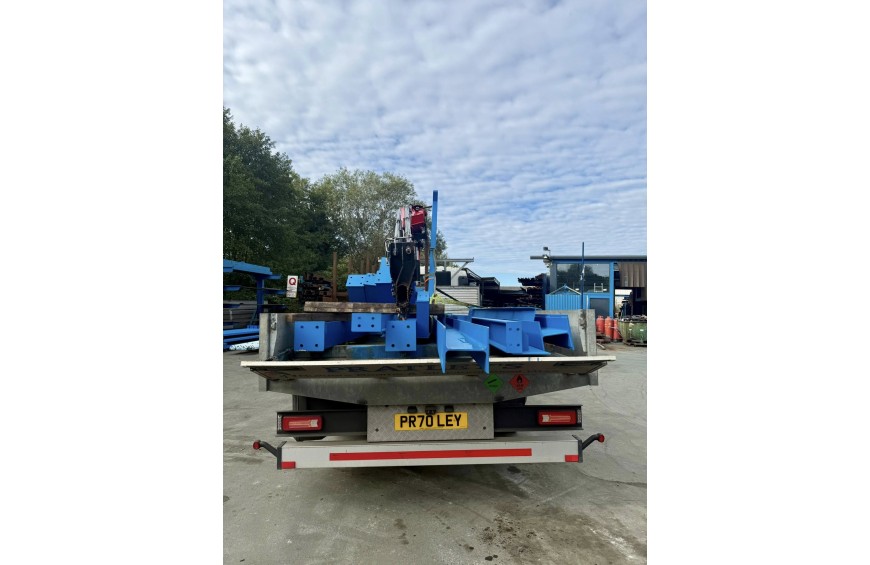
When specifying structural steel sections for construction projects, two of the most common profiles you'll encounter are Universal Beams (UB) and Universal Columns (UC). While they may look similar at first glance, these I-section steel members are designed for fundamentally different structural roles. Understanding their characteristics and optimal applications is essential for safe, efficient structural design.
What Are Universal Beams and Universal Columns?
Both UBs and UCs are hot-rolled steel sections with an I-shaped cross-section, consisting of two horizontal flanges connected by a vertical web. They're called "universal" because they're produced to standardized dimensions and are widely available across international markets. However, their proportions differ significantly to suit their intended purposes.
Universal Beams are characterized by their relatively narrow flanges and greater depth compared to width. A typical UB might have a depth-to-width ratio of approximately 2:1. For example, a 457×152 UB is 457mm deep but only 152mm wide.
Universal Columns, in contrast, have much broader flanges that are closer in dimension to their depth, creating a more square-like profile. A typical UC might have flanges nearly as wide as the section is deep, with ratios approaching 1:1. A 254×254 UC, for instance, is essentially square in cross-section.
Key Structural Differences
The dimensional differences between UBs and UCs reflect their distinct structural purposes and performance characteristics.
Moment of Inertia and Bending Resistance
Universal Beams are optimized for resisting bending moments about their major (strong) axis. Their greater depth places more material further from the neutral axis, maximizing the second moment of area in the direction where beams typically experience the greatest bending. This makes UBs highly efficient when spanning horizontally between supports, where loads create downward deflection.
Universal Columns, with their broader flanges, provide more balanced resistance to bending in both axes. While they still have a strong and weak axis, the difference is less pronounced than in UBs. More importantly, UCs have a larger cross-sectional area and radius of gyration, making them superior for resisting axial compression loads, which is the primary loading condition for vertical columns.
Buckling Resistance
Column buckling is a critical design consideration for compression members. The broad flanges of UCs provide greater lateral stability and a larger radius of gyration about both axes, significantly improving resistance to buckling. The more balanced geometry reduces the slenderness ratio, allowing UCs to carry higher axial loads without requiring additional lateral restraint.
Universal Beams, being narrower, have a much smaller radius of gyration about their weak axis. If used as columns, they would be highly susceptible to buckling about this axis unless frequently restrained laterally, which is often impractical in real construction scenarios.
Connection Flexibility
The wider flanges of Universal Columns provide more surface area for bolted connections, making it easier to attach beams from multiple directions. This is particularly valuable at building corners or where several beams frame into a single column from different angles. The broader flange also accommodates larger bolt patterns and provides better distribution of connection forces.
Universal Beams, while having narrower flanges, are typically easier to connect to other beams or to columns using standard connection details like fin plates, web cleats, or end plates.
When to Use Universal Beams
Universal Beams are the appropriate choice whenever the primary loading is bending rather than compression. Common applications include:
Floor and roof beams spanning between columns or walls represent the classic UB application. The horizontal member supports distributed loads from slabs, decking, or joists above, creating bending moments that UBs are specifically designed to resist efficiently.
Lintels above openings in masonry or concrete walls benefit from the UB profile, where the beam spans across doors or windows and carries the wall load above. The depth of the UB provides the moment capacity needed without excessive deflection.
Purlins and side rails in portal frame buildings typically use lighter UB sections to span between the main frames, supporting roof or wall cladding.
Transfer beams that carry loads from columns above, redistributing them to supports at different locations, often employ heavy UB sections due to their excellent bending capacity.
The key consideration when selecting a UB is ensuring adequate lateral restraint to prevent lateral-torsional buckling. Concrete floor slabs, metal decking, or regular bracing connected to the compression flange can provide this restraint.
When to Use Universal Columns
Universal Columns are essential where axial compression is the dominant load case. Primary applications include:
Vertical building columns carrying loads from multiple floors above represent the quintessential UC application. The axial load increases cumulatively from the roof down to the foundations, and the UC's cross-sectional area and buckling resistance make it ideal for this duty.
Portal frame columns in industrial and commercial buildings use UC sections to resist both axial loads and bending moments from the frame action. The stockier profile handles the combined loading effectively.
Heavy compression members in trusses or braced frames benefit from the UC's superior buckling performance when carrying significant compressive forces.
Situations requiring multi-directional beam connections, such as at building corners or complex junctions, favor UCs due to their wider flanges that accommodate connections from various angles.
In unusual circumstances where a beam must carry extreme loads over a short span, a UC might be selected for a horizontal member. The additional material provides extra capacity, though this is generally less material-efficient than using a deeper UB section.
Performance Comparison Example
To illustrate the practical differences, consider a comparison between a UB and UC of similar mass. A 203×203×52 UC (52 kg/m) and a 254×146×43 UB (43 kg/m) are both medium-weight sections, but their performance diverges significantly based on loading conditions.
For bending about the major axis, the deeper UB section would provide superior moment capacity despite being lighter, thanks to its greater depth placing material further from the neutral axis. Its elastic section modulus about the major axis would be substantially higher.
For axial compression, the UC would dramatically outperform the UB. Its larger cross-sectional area directly increases compression capacity, while its greater radius of gyration about both axes reduces slenderness and improves buckling resistance. For a typical column length, the UC might carry two to three times the axial load of the UB.
This example demonstrates why selecting the right section type for the loading condition is crucial for both structural adequacy and material efficiency.
Design Considerations
Several factors beyond basic strength should influence your choice between UBs and UCs.
Serviceability and deflection often govern beam design more than ultimate strength. The greater depth of UBs provides superior stiffness for controlling deflection under service loads, which is critical for preventing damage to finishes, partitions, and preventing vibration issues in floors.
Fire resistance requirements may favor UCs in column applications, as their greater mass-to-surface-area ratio means they heat up more slowly in fire conditions. However, both section types typically require additional fire protection in buildings.
Fabrication and erection efficiency should be considered. UCs may require less bracing during construction, as their inherent stability makes them less prone to buckling during erection before lateral restraints are fully in place.
Architectural coordination matters too. The slimmer profile of UBs may be preferable where minimizing structural depth is important for ceiling heights, while UC columns may be preferred where a more substantial appearance is desired or where cladding attachment is simplified by wider flanges.
Material Efficiency and Cost
From a pure material efficiency standpoint, using the right section for the right application saves steel. A UB optimized for bending uses material efficiently by concentrating it at the section extremities vertically. Using a UC as a beam would mean paying for extra flange width that contributes little to major-axis bending capacity.
Conversely, attempting to use a UB as a column typically requires additional bracing to prevent buckling, adding complexity and cost that would be avoided by simply specifying the appropriate UC section from the start.
While UCs generally have more mass per meter due to their heavier flanges, this shouldn't be viewed simply as excess material. In column applications, this mass is working efficiently to resist axial loads and buckling, whereas a lighter UB would require a longer section with more material to achieve equivalent performance.
Conclusion
The distinction between Universal Beams and Universal Columns reflects fundamental principles of structural mechanics. UBs are optimized for bending through their depth, making them ideal for horizontal spanning members. UCs are optimized for compression through their cross-sectional area and buckling resistance, making them essential for vertical load-bearing columns.
Selecting the appropriate section type requires understanding your primary loading condition. For beams carrying transverse loads and experiencing bending, specify UBs. For columns carrying axial loads, specify UCs. While exceptions exist for special situations, this basic principle guides efficient, safe structural design.
The key to successful specification lies in matching the section geometry to the structural demand, ensuring that material is positioned where it works most effectively for the loads it must resist. This approach delivers structures that are both economical and robust, embodying the fundamental engineering principle of placing the right material in the right place for the right purpose.

Submit comment Cancel Reply