

The budget conversation usually happens about three weeks into a renovation. The contractor calls, there's a pause, and then comes the phrase that every homeowner learns to dread: "We've opened up the wall and found something."
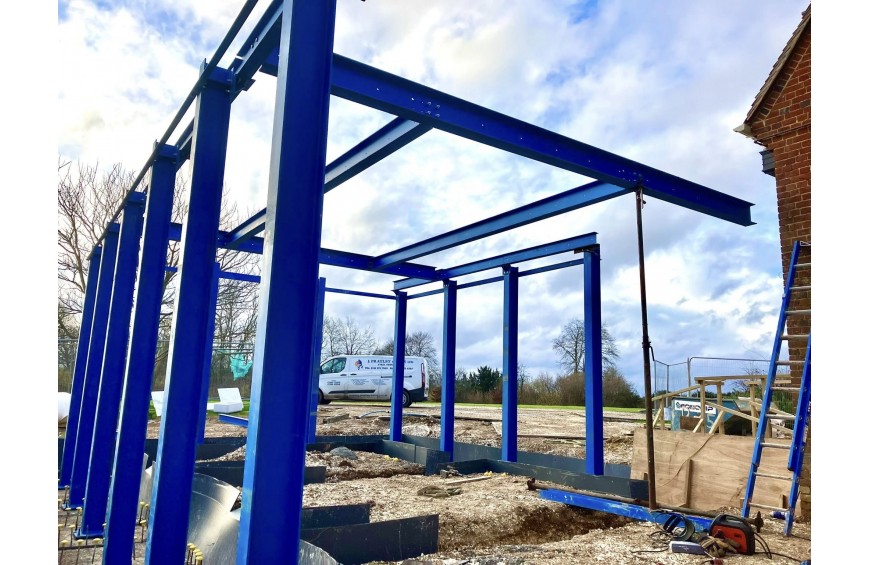
That something is usually structural. And in older UK housing stock — Victorian terraces, Edwardian semis, interwar bungalows, postwar estate houses — it tends to mean steel that wasn't in the original scope, wasn't priced for, and can't really be avoided.
This isn't a story about cowboy builders or bad luck. It's a story about how houses built before modern structural standards work, what they're hiding, and why the gap between what's on a survey and what's actually inside a wall is so consistently wide.
The Age of the Building Is the First Warning Sign
The UK has one of the oldest housing stocks in Europe. Around a third of all homes were built before 1945, and a significant proportion of those before 1919. These buildings weren't designed with future renovation in mind. They were built to last — and they have — but they were built using methods, materials, and structural logic that doesn't always translate cleanly to modern open-plan living or changed use patterns.
When someone buys a Victorian terrace and decides to knock through the ground floor, they're not just removing a wall. They're intervening in a structural system that was designed as an integrated whole, has been sitting in equilibrium for over a century, and almost certainly has features that aren't visible from the outside.
The structural engineer or building inspector can tell you what needs to happen. What they often can't tell you — until work begins — is exactly what you'll find when you start opening things up.
Chimney Breasts: The Hidden Load-Bearer
Chimney breasts are one of the most consistently surprising features in Victorian and Edwardian houses. In a typical mid-terrace, the chimney stack runs up through multiple floors, and the breast projects into each room it passes through. It looks like a decorative feature — redundant since the house went onto central heating, awkwardly placed, an obvious candidate for removal if you want a flush wall or a more usable room layout.
What it actually is, in many cases, is a significant load-bearing element.
The problem is compounded by the history of the house. Many chimney breasts were removed at floor level — often in the 1960s or 1970s when solid fuel heating fell out of favour — without removing the breast above. The result is a chimney breast on the first floor that is effectively suspended: it's no longer sitting on anything solid at ground level, and the load it carries is being transferred through the floor structure in ways that were never designed for.
This situation is far more common than most people expect, and a general survey won't necessarily catch it. An experienced surveyor working for a buyer may note that a chimney breast has been removed at ground level. They are less likely to identify, from a visual inspection, whether the structure above has been properly supported — or whether it's been sitting in precarious equilibrium for fifty years.
When demolition starts on a ground floor extension or a kitchen refurbishment, and the full picture becomes visible, a steel beam is almost always the right solution. The breast above needs to bear on something, and timber won't do the job reliably over the spans involved.
Timber That Has Had a Difficult Century
The timber in older houses is often excellent — dense, slow-grown hardwood that modern structural timber can't match for quality. But it has also had a hundred years or more of things happening to it.
Wet rot. Dry rot. Beetle infestation. Previous owners who cut notches and holes without thinking about what they were cutting through. Inadequate ventilation under suspended floors that has allowed moisture to accumulate. Joist ends sitting in external walls without any form of protection, slowly deteriorating at the bearing point where they carry the most load.
None of this is necessarily visible from a standard survey. A surveyor walking through a house will look for signs of movement, damp, or obvious distress. They won't lift every floorboard, open every ceiling, or probe every joist end. The condition of the structural timber is, in many cases, genuinely unknown until work begins.
When a renovation involves opening up floors or ceilings — for underfloor heating, for rewiring, for insulation, for a structural change — it often reveals timber that is in much worse condition than expected. At that point, decisions have to be made. Sistering a weakened joist is sometimes possible. Where decay is extensive, or where a joist has been so heavily notched as to be structurally unreliable, replacement or supplementary steel becomes the practical answer.
The issue isn't always complete failure — it's adequacy. A joist that has been doing its job for a century under the existing loading might not be adequate once a heavier floor finish is installed, or once a new load path from above is introduced. Structural adequacy isn't a binary question. It's a question of whether what's there is sufficient for what's planned, and that calculation often produces a different answer in an old house than a new one.
Uneven Load Paths and the Logic of Old Construction
Modern structural design works from clear principles: loads travel down through a defined hierarchy of elements to the foundations. It's traceable. In a Victorian terrace, the structural logic is real but it's less tidy.
Walls that look like partitions are often load-bearing. Walls that look substantial are sometimes just lath and plaster over a light timber frame. Floors at the front of the house may span differently from floors at the rear. The rear addition — almost universal in Victorian terraces, almost always built slightly later and slightly less carefully than the main house — connects to the original structure in ways that create unusual load concentrations.
When an owner wants to remove what appears to be a simple partition wall to open up a kitchen-diner, the first question is whether it's actually a partition. The second question — less often asked before work starts — is what's above it, and whether what's above it is itself bearing on something that the apparently-simple-partition is quietly keeping in place.
This is where the phrase "unintended load path" comes from. A wall doesn't have to have been designed as structural for it to be carrying load. Over time, structures settle and redistribute. Elements that weren't in the original load path can become part of it as the building finds its equilibrium. Removing them without understanding this — or without providing an alternative load path — can cause movement that ranges from annoying (cracked plaster, sticking doors) to serious (wall tie failure, partial collapse).
A steel beam specified by an engineer and installed correctly provides a reliable alternative load path. That's often a simpler solution than trying to figure out the full history of a wall and whether anything important is resting on it.
What Demolition Reveals That Surveys Can't
There's a category of problem that no survey will find, because surveys are non-invasive. You look, you probe, you check for surface signs of distress. You don't open things up.
Demolition does open things up, and what it finds is often instructive.
Old steel from a previous renovation, undersized and unchecked, sitting in a wall doing a job that's never been formally assessed. Timber lintels over openings — sometimes rough-cut sections of whatever was to hand — that have been carrying load for decades and are now showing significant deflection or decay. Foundations that are shallower than expected, or that bear on made ground rather than undisturbed soil, changing the calculations for anything that will add load above them.
Wall construction that isn't what it looked like from the outside. Many pre-1919 properties have solid brick walls; some have a mix of solid and cavity; some have unusual construction methods that reflect local materials or local building traditions. A house that looks like a straightforward brick-and-timber structure can reveal almost anything once the plaster comes off.
Each of these findings creates a decision point. Some of them create a requirement for steel that was never anticipated: a beam to carry what the decayed lintel was carrying, a padstone to distribute load that would otherwise sit on a crumbling brick course, a column to carry a load from above while foundations are underpinned.
Planning for the Unexpected
The practical lesson from all of this isn't that older houses are dangerous or that renovation is a trap. It's that the budget and programme for any significant renovation of pre-1945 housing should include a genuine contingency — not a notional 10% tacked onto a tight estimate, but a real allowance for the realistic probability that steel will be needed somewhere it wasn't initially anticipated.
An experienced contractor working on older properties will tell you this directly. The ones who don't have usually learned the hard way, or are telling you what you want to hear.
A structural engineer involved early — before demolition rather than after — can't eliminate surprises, but they can identify the higher-risk areas, design flexibly enough to absorb some of what's found, and move faster when something unexpected turns up. The alternative is waiting for the discovery, getting an engineer in reactively, waiting for drawings, sourcing steel, and watching the programme slip.
Older houses are worth renovating. The bones are often genuinely excellent, and the character isn't replicable. But they carry their history inside them, and that history doesn't always make itself known until someone starts taking things apart.
Pratley's Builders Beams supplies universal beams, columns, and structural steel sections for domestic renovation projects across the UK. If you're working on an older property and need sections cut to length and delivered quickly, get in touch with our team.

Submit comment Cancel Reply