

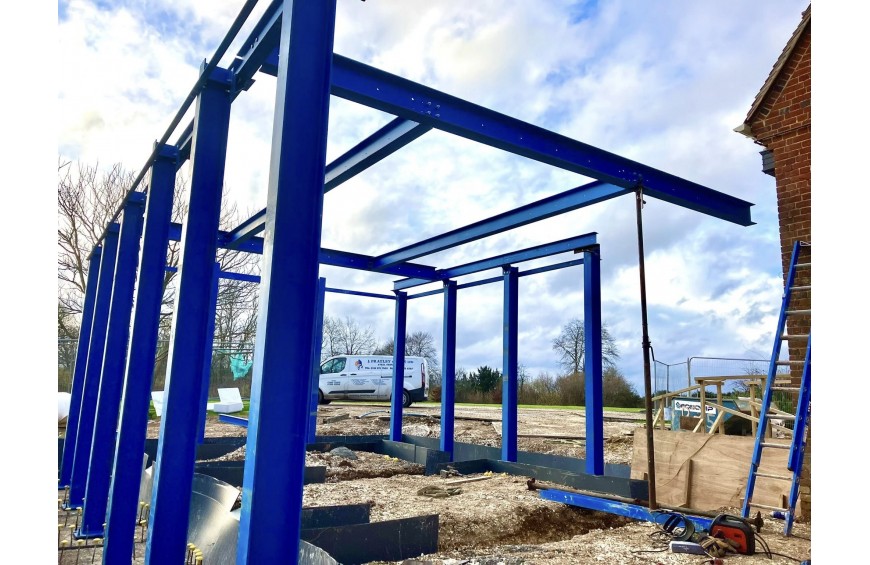
The assumption most people bring to steel beam pricing is straightforward: a bigger beam costs more than a smaller one. This is true in the narrowest sense — a heavier section has more steel in it and steel is priced by weight, so the raw material cost of a larger section is higher. But raw material cost is rarely the dominant variable in what a beam actually costs to supply. For fabricated steelwork, which covers the majority of beams used in real construction projects, the work that goes into the beam — the cuts, the holes, the plates, the coating, the delivery — frequently costs more than the steel itself.
Understanding the actual cost drivers in steel beam supply matters for two practical reasons. It allows more accurate budget estimation, which means fewer surprises when quotes come in. And it identifies where money can be saved by making different specification choices — choices that do not compromise the structural design but that have a significant effect on the supply cost.
The Raw Material Baseline
Steel sections are produced in standard rolling mills and sold by weight, priced against a base rate per tonne that moves with the steel market. A 254x146x37 UB — 37 kilograms per linear metre — costs more per metre than a 203x102x23 UB at 23 kilograms per metre. That much is as assumed.
But two things qualify this baseline immediately.
First, the steel market price fluctuates. In periods of supply constraint or high demand, the tonne rate rises. In quieter periods it falls. A beam quoted at one price in January may cost differently in June — not because the specification changed, but because the input cost changed. For projects with long lead times between specification and order, this is worth accounting for.
Second, section availability affects effective cost. Standard sections in common lengths are held in stock by most steel stockholders and suppliers. Less common sections, or common sections in lengths at the upper end of the rolling range, may require mill orders with longer lead times — or may need to be cut from longer lengths, generating offcuts that are charged to the order. A section that is nominally cheaper per tonne but requires a mill order may cost more in total, and deliver later, than a slightly heavier common section that is in stock.
Stock availability is one of the less-discussed variables in beam cost, and it is the one most likely to affect programme as well as price.
Fabrication: Where Most of the Cost Is Added
For most beams supplied for real construction projects, fabrication adds more to the final cost than the steel itself. Fabrication covers everything done to the raw section after it leaves the rolling mill: cutting, drilling, welding of connection plates and stiffeners, and surface preparation.
Cutting. A beam cut to a precise length costs more than a beam supplied at standard stock length. The cutting operation itself is quick, but it adds setup time, material handling, and waste accounting to the order. Beams cut at angles — to sit flush against a sloping surface, or to fit a non-perpendicular connection — require more complex cutting operations and therefore more cost than a straight square cut.
Minimising the number of non-standard cuts in a project reduces fabrication cost. Where the design allows, specifying beams to standard lengths, or to lengths that can be cut from a standard stock length without waste, is a straightforward way to keep cost down.
Drilling and notching. Holes drilled through flanges or webs for bolted connections are individually inexpensive but accumulate across a project with multiple connection points. A beam with four bolt holes at each end — a standard end plate connection — is a different fabrication job to a beam with a complex connection detail requiring a large bolt group, weld-on brackets, and access holes for installation. The engineer's connection detail drives this, and complex connections cost more than simple ones. This is not an argument for under-specifying connections, but it is a reason to value the simplest connection that meets the structural requirement.
Welded attachments: plates, stiffeners, and cleats. The most significant fabrication cost items are welded attachments — end plates, column stiffeners, gusset plates, and any bracket or cleat welded to the section in the fabrication shop. Each attachment requires setup, positioning, welding, and in some cases inspection. A beam with an end plate welded to each end for a moment connection is more expensive to fabricate than a simple beam with no attachments, even if the beam section is the same.
Stiffeners — plates welded inside the column web at the level of the beam flanges to prevent web buckling at a moment connection — add particular cost because they require precise positioning and a number of welds in an awkward location. A connection detail that requires column stiffeners is more expensive than one that does not. Where the structure can be arranged to avoid stiffeners — by using a heavier column section with a web that does not need reinforcing, or by adjusting the connection geometry — there is a cost case for doing so.
The fabrication complexity multiplier. The practical way to think about fabrication cost is as a multiplier on the base material cost that increases with every non-standard operation. A plain beam cut to length: low multiplier. A beam cut to length with end plates welded and holes drilled: moderate multiplier. A beam with end plates, stiffeners, intermediate cleats, complex cuts, and a requirement for weld inspection: high multiplier. Two beams of the same section and length can have very different supply costs depending on what has been specified in their fabrication.
Coatings: Priming, Galvanising, and Intumescent
The surface coating applied to a steel beam before delivery adds cost that is entirely separate from the section size and fabrication content, and that varies significantly depending on the specification.
No coating (bare/mill finish). Beams supplied in their as-rolled condition — with the mill scale intact but no applied coating — are the cheapest option from a supply perspective. This is appropriate for beams that will be encased in concrete, permanently enclosed in building fabric, or that will be coated by others on site. It is not appropriate for beams in exposed conditions or in environments where corrosion is a risk.
Shot blast and primer. The standard coating specification for structural steelwork that will be painted on site or that needs basic corrosion protection during construction is shot blasting to Sa 2.5 followed by a single coat of epoxy or etch primer. This provides a clean substrate for any subsequent coating and significantly improves adhesion and durability compared to mill scale. The cost addition is moderate and in most cases represents good value for the protection it provides.
Hot-dip galvanising. Galvanising — immersing the fabricated beam in molten zinc — provides a comprehensive, long-life corrosion protection that is appropriate for external steelwork, agricultural buildings, beams in high-humidity environments, or any application where long-term performance without maintenance repainting is required. It is significantly more expensive than primer coating, and it has a processing implication: fabricated beams for galvanising must be designed with adequate drainage holes and vent holes to allow the zinc to penetrate and flow through hollow sections and enclosed spaces. A fabricated assembly that has not been designed for galvanising — with sealed boxes, trapped sections, or inadequate drainage — cannot be safely galvanised, and retrofitting the required holes may require re-engineering.
Lead times for galvanising are also longer than for primer coating, as the work is typically carried out by specialist galvanisers rather than in the fabrication shop. This needs to be accounted for in the project programme.
Intumescent fire protection. As covered in a separate article, intumescent coatings add cost that depends on the section factor of the beam and the required fire resistance period — lighter sections require thicker coatings and therefore more material and more application time than heavier sections for the same resistance period. Intumescent applied in the fabrication shop, over a correctly prepared substrate, is more consistently controlled and therefore more reliably compliant than site-applied coating. For projects where fire protection is a requirement, including the intumescent in the fabrication scope is worth the cost, because it eliminates a coordination risk on site.
Custom vs Stock: When Each Makes Sense
The most significant binary cost decision in beam procurement is whether to order from stock or to specify a custom fabrication.
Stock sections are standard UB and UC sections held in common lengths by steel stockholders and specialist suppliers. They can typically be supplied cut to length quickly — same day or next day for common sections — at a price that reflects the efficiencies of volume production and immediate availability. For the majority of residential and light commercial beam requirements, a stock section cut to length, with or without simple end plates fabricated in-house, is the most cost-effective solution.
Custom fabrication is appropriate where the project requires a section that is not available from standard stock — a built-up plate girder for a long span that exceeds the standard rolled section range, a castellated or cellular beam for a specific depth-to-weight requirement, or a fabricated assembly that integrates multiple structural functions. Custom fabrication costs more than stock supply in almost every case, and has a longer lead time. It is the right choice when the structural requirement genuinely demands it — not as a default, and not as a way to avoid the minor inconvenience of specifying to available stock sections.
A common source of unnecessary cost in residential beam projects is specifying a custom fabrication when a stock section would do the job — usually because the initial design was carried out without reference to available section sizes, and the engineer sized the beam to the exact calculated requirement rather than to the nearest practical stock section. A beam calculated to require a 275x135x35 UB (a section that does not exist in the standard range) will be fabricated as a custom item unless the engineer is asked to review whether a 254x146x37 or a 305x102x33 achieves the same structural result from standard stock. It usually does.
Delivery: The Variable Nobody Budgets For
Delivery cost is the line item most likely to be missing from early budget estimates, and on constrained or remote sites it can represent a significant proportion of the total supply cost.
Standard delivery — a flatbed or curtainsider vehicle to a site with adequate access, within a reasonable radius of the supplier — is typically included in the quoted price or added at a flat rate. What changes the cost is everything that makes the delivery non-standard.
Restricted access requiring a smaller vehicle than standard means more deliveries for the same quantity of steel, or a vehicle hire specifically sized for the site. Narrow streets, weight-restricted roads, or bridge crossings with load limits all feed into vehicle selection and therefore delivery cost.
HIAB or crane-off delivery — where the beam is lifted directly off the vehicle and into position using a vehicle-mounted crane — costs more than standard offload, but may be the most efficient option for sites where the beam cannot be walked in or where no separate crane is available for the lift.
Timed or restricted-hour delivery — required in urban areas where deliveries must occur within specific windows to comply with local authority conditions or to avoid peak traffic — may require dedicated vehicle allocation rather than routing the delivery alongside others, with a cost premium to match.
Multiple drops from a single fabrication order — delivering beams to different sites or at different project stages — each carry their own delivery cost, and splitting an order across multiple deliveries costs more in total than a single consolidated drop.
Delivery cost is not an afterthought. On a project where the steel value is modest and the site is genuinely constrained, it can represent 15% to 20% of the total supply cost. Getting a delivery quote that reflects the actual site conditions — including access constraints, timing restrictions, and required offload method — at the same time as the beam quote gives an accurate total cost picture rather than a partial one.
The Real Cost Framework
The cost of a steel beam, fully supplied to site ready for installation, is the sum of:
Material cost (section size × length × steel rate) + fabrication cost (cuts, holes, plates, stiffeners, and their associated welding and preparation) + coating cost (primer, galvanising, intumescent, or none) + delivery cost (vehicle type, distance, access, timing, and number of drops).
Of these, material cost is the most visible and the one most builders focus on. Fabrication, coating, and delivery are the variables that actually differentiate one quote from another, and they are the variables over which the specifier has the most influence.
A heavier section with simple end plates, a primer coat, and standard delivery may cost less than a lighter section with complex stiffened connections, a galvanised finish, and a HIAB drop to a restricted urban site. The assumption that bigger means more expensive is a starting point, not a pricing model.
Pratley's Builders Beams supply standard and fabricated structural steelwork for residential and commercial projects across the UK. For a quote that breaks down material, fabrication, coating, and delivery as separate line items, talk to our team — we'd rather you understand what you're paying for.

Submit comment Cancel Reply