

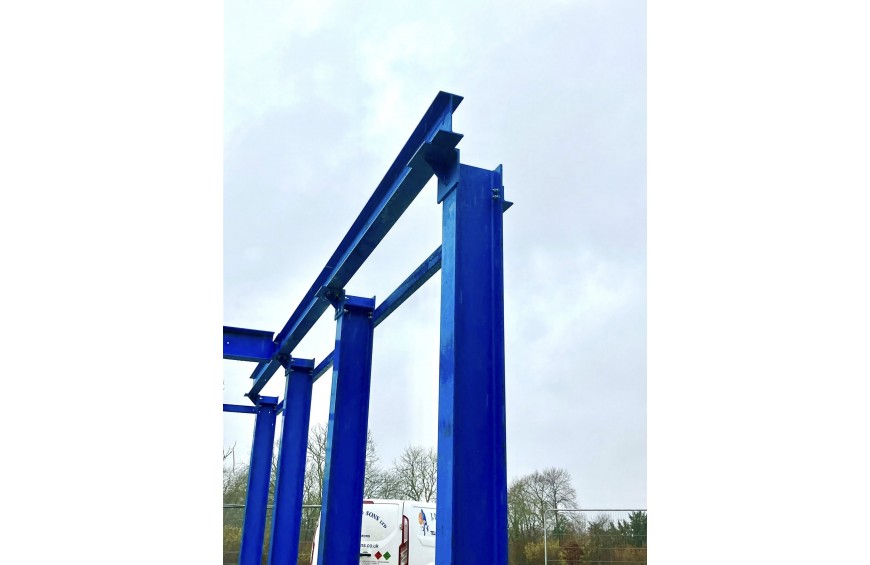
Specifying the right beam is half the job. How that beam connects to the structure around it is the other half — and it's where a significant number of problems on site originate.
Beam connections are one of the less-discussed aspects of structural steelwork, particularly at the builder and small contractor level where the steel has often been specified by an engineer and arrives on site with the expectation that installation is straightforward. In most cases it is. But understanding what type of connection has been specified, why, and what the practical implications are for installation and sequencing is knowledge that prevents errors, speeds up the job, and means fewer questions going backwards to the engineer mid-project.
There are two fundamental connection types in structural steelwork: bolted and welded. In practice, most real-world connections are one, the other, or a deliberate combination of both. Each has a distinct set of applications, advantages, and constraints. The choice between them is not arbitrary — it reflects decisions about structural behaviour, programme, site conditions, and cost that the engineer has already made by the time the steel arrives on site.
This article explains how each works, where each is used, and what that means for the people receiving and installing the steel.
What a Beam Connection Is Actually Doing
Before the bolted-versus-welded question, it's worth being clear about what a connection is required to do — because the structural demand is what drives the specification.
A beam in a structure carries load. It transfers that load to the elements it connects to — columns, walls, other beams, or foundations. The connection is the interface through which that transfer happens, and it needs to be capable of handling the forces involved without failing, deforming beyond acceptable limits, or allowing movement that the structure was not designed to accommodate.
The nature of those forces matters. A connection may need to carry shear force — the vertical load of the beam's span acting downward at the support. It may also need to carry moment — the rotational force generated when a beam is fixed at its end rather than simply resting on its support. Or it may be designed to carry both.
Simple connections carry shear only. They allow the beam end to rotate slightly, which means the beam behaves as simply supported — it deflects under load but does not transfer significant bending moment into the supporting element. These are typically the lighter-duty, more straightforward connections used in most domestic and light commercial work.
Moment connections are stiffer. They resist rotation at the beam end, creating a rigid or semi-rigid joint that transfers bending moment into the supporting structure. They are used where continuity of structural behaviour across the joint is required — in portal frames, in multi-storey structures, or where deflection control demands a stiffer system than simple connections provide.
This distinction is foundational to the bolted-versus-welded question, because the two connection types have different inherent capacities to achieve these behaviours.
Bolted Connections: The Site-Practical Choice
The bolted connection is the standard for most on-site steelwork assembly, and for good reason. It requires no heat, no specialist welding equipment, no hot work permit, and can be carried out by a competent steel erector with the right tools. It is fast, inspectable, and — critically — adjustable and reversible in a way that welded connections are not.
How bolted connections work on-site. In a typical bolted beam connection, the beam end is fitted with a cleat or end plate — a steel plate welded to the beam in the fabrication shop — through which bolts pass into the supporting element. The supporting column or beam will have a corresponding plate or cleated bracket, also fabricated in the shop, already in position for the bolt group to connect to.
On site, the beam is lifted into position, the holes are aligned, and the bolts are inserted and tightened to the specified torque. The entire operation — for a single beam end with a simple shear connection — typically takes minutes with a competent team and the right equipment.
The bolt types matter. Structural connections use either ordinary structural bolts (grade 8.8 in most specifications) or, for higher-load or slip-critical connections, high-strength friction grip (HSFG) bolts. HSFG bolts work differently — they are tightened to a high preload that clamps the connected plates together, so that load is transferred through friction between the surfaces rather than through bolt shear. They are specified where connection slip cannot be tolerated and where the engineer needs a more controlled and consistent load path.
For most residential and light commercial beam connections, ordinary grade 8.8 bolts in standard clearance holes are adequate. The engineer's connection detail will specify what is required.
The advantages of bolted connections are practical and meaningful. Speed of erection — a bolted frame goes up faster than a welded one because the preparatory work is done in the shop and the site operation is assembly rather than fabrication. Reversibility — bolts can be removed if a beam needs to be adjusted or replaced, which matters in alteration and extension work where the sequence of operations may require temporary removal. Inspectability — a bolted connection is visible and its tightness is verifiable in a way that a completed weld is not without specialist inspection equipment.
The limitations are structural. Bolted simple connections — cleated or fin-plate connections — are inherently flexible at the joint. They work for simple beam spans where moment transfer is not required, but they are not suited to moment-resistant connections without more complex detailing, larger bolt groups, and substantial end plates. A standard bolted cleat connection is not a moment connection. If the engineer has specified moment resistance at the joint, a bolted detail will look different — larger, more heavily plated — and will be explicitly detailed rather than inferred.
Welded Connections: The Fabrication Shop's Domain
Welding creates a continuous, integral bond between steel elements that a bolted connection cannot replicate. A well-executed full-penetration weld between a beam flange and a column face can develop the full plastic moment capacity of the beam — a structural performance that bolted connections achieve only with complex and expensive detailing.
For this reason, welded connections are the standard for moment-resistant joints in frames where structural continuity across the joint is central to how the building works. Portal frames, in which the rafter-to-column connection must transfer moment to give the frame its lateral stability, are almost universally designed with welded moment connections. Multi-storey moment frames use welded beam-to-column connections where continuity of stiffness is required.
Shop welding versus site welding. The critical distinction here is where the welding happens. Shop welding — carried out in a controlled fabrication environment with proper fixturing, skilled welders working in comfortable positions, and full quality control — produces consistently high-quality welds. Site welding is a different proposition: exposure to weather, constrained access, working at height or in awkward positions, and the difficulty of maintaining consistent preheat and weld quality in conditions that are not controlled.
For these reasons, site welding is avoided wherever possible in structural connections. Where welding is required in the connection design, the standard approach is to maximise the shop-welded content — attaching plates, stiffeners, and brackets in the fabrication shop — and minimise what needs to happen on site. The resulting detail often allows site bolting to connect shop-welded assemblies.
Where site welding does occur, it is typically under the supervision of a qualified welding inspector, using procedures qualified to the relevant standard (BS EN ISO 3834 being the current framework for quality requirements in fusion welding), with weld inspection — visual, and in some cases ultrasonic or magnetic particle inspection — as a specified requirement.
The Hybrid Approach: Shop-Welded, Site-Bolted
In practice, the most common connection detail for structural steelwork of any significance is not purely bolted or purely welded — it is a hybrid: fabricated in the shop using welding to attach connection components to the beam and column, then assembled on site using bolts.
A typical example is the extended end plate moment connection. In the fabrication shop, a thick end plate is welded to the beam end — full-penetration welds to the flanges, fillet welds to the web, in positions and at dimensions specified by the engineer. On site, the beam is positioned against the column face, and high-strength bolts are passed through the end plate and into corresponding threaded holes or nut plates in the column flange, and torqued to specification.
The result is a connection that achieves the structural performance of a welded moment joint while retaining the site practicality of bolted assembly. The welds — where quality is most critical and most controllable — are done in the shop. The site operation is bolt tightening.
This hybrid approach underlies most modern structural steelwork for residential extensions, commercial buildings, and industrial structures. When an engineer's drawing shows a "bolted end plate connection" with a thick plate and multiple bolt rows, they are specifying this system — the welding is assumed as part of the fabrication process, and the bolting detail is what the site operatives are assembling.
What This Means When the Steel Arrives on Site
For the builder or contractor receiving fabricated steelwork, the practical implications of connection type come down to a few key points.
Check the connection details before erection begins. The structural engineer's drawings will show the connection type, bolt specification, plate dimensions, and bolt group layout for each connection. These details are not suggestions — they are the specification to which the connection must be built. Installing the wrong bolt grade, omitting stiffeners, or modifying plate positions to suit site convenience changes the structural behaviour of the connection in ways the engineer cannot have accounted for.
Bolted connections require accurate hole alignment. Clearance holes in steelwork are typically 2mm larger than the bolt diameter — enough to allow for minor misalignment in fabrication and erection. Significant misalignment that requires holes to be enlarged on site should be discussed with the engineer before it is done. Enlarging holes beyond the specified clearance reduces the bolt group's capacity.
Torque matters. Structural bolts need to be tightened to the specified torque — not just hand-tight, and not tightened to whatever feels adequate. For ordinary grade 8.8 bolts, a calibrated torque wrench is the standard method. For HSFG bolts, the tightening procedure is more specific and must follow the method in the connection specification.
Any site welding required should be flagged early. If a connection cannot be made as specified without site welding, this is a conversation that needs to happen before erection, not during it. The engineer needs to assess whether site welding is acceptable, what procedure should be used, and whether inspection is required.
The Engineer's Decision, Not the Site's
The most important thing to carry away from this is that the connection type is an engineering decision, not a site decision. The choice between bolted and welded, simple and moment, standard plate and extended end plate has been made based on the calculated forces at that joint, the structural system the building is designed to work as, and the specified performance of the overall frame.
The site's job is to build the connection as specified. Understanding why the connection has been specified as it has — what it is being asked to do, what the bolt grade is there for, why the end plate is the thickness it is — makes that job more reliable and considerably less likely to generate problems that surface only when the structure is loaded.
Pratley's Builders Beams supply fabricated structural steelwork for residential and commercial projects across the UK. Whether you need standard stock beams or a fabricated connection detail to specification, talk to our team.

Submit comment Cancel Reply