

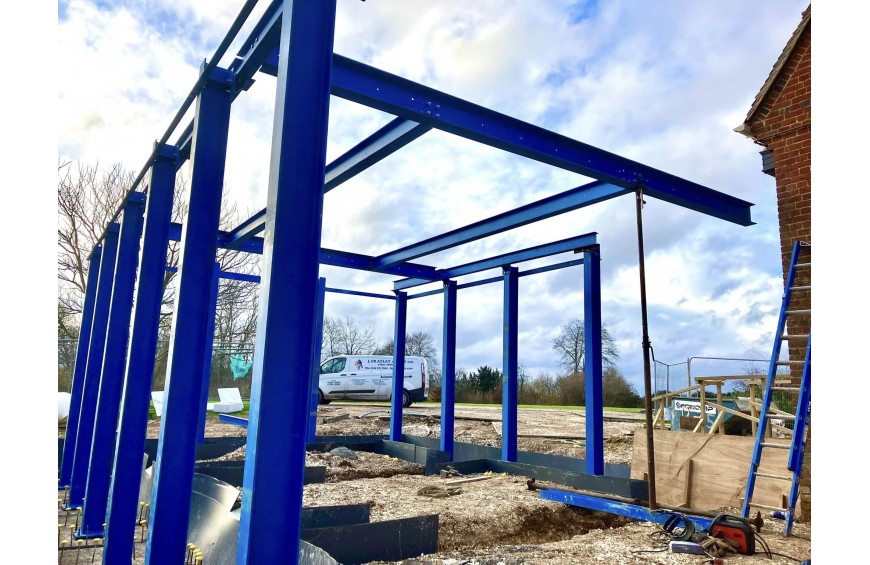
Steel grade specifications appear on every structural calculation and beam schedule—S275, S355, occasionally S460—yet many builders, self-builders, and even some engineers treat grade as interchangeable detail rather than critical design parameter affecting beam performance, cost, and structural adequacy. The difference between S275 and S355 steel extends far beyond the numbers, determining whether your chosen beam section achieves required strength and deflection performance, whether smaller/lighter sections can replace heavier alternatives, and ultimately whether your structural solution is optimized for performance and cost or simply "good enough" using conservative oversizing.
For anyone specifying or purchasing steel beams for UK residential, commercial, or light industrial projects—removing load-bearing walls, supporting roof structures, creating mezzanines, or reinforcing existing structures—understanding steel grades transforms beam selection from guesswork into informed optimization. The reality is that steel grade directly affects load-carrying capacity, deflection performance, and beam weight, with higher grades enabling lighter, shallower, or longer-spanning solutions that conventional S275 specifications can't achieve. However, higher grades cost more per tonne and aren't universally available in all sections, making grade selection an engineering and economic trade-off requiring understanding rather than default assumptions.
This guide explains what steel grades actually mean structurally, demonstrates how grade affects beam performance through calculations and real-world examples, identifies situations where upgrading from S275 to S355 delivers value, clarifies when standard S275 is perfectly adequate, and provides decision framework enabling informed steel grade selection for your specific project requirements.
Understanding Steel Grades: What the Numbers Mean
Steel grade designations follow European Standard EN 10025, with the number indicating minimum yield strength in Newtons per square millimetre (N/mm² or MPa).
Yield Strength: The Critical Property
Yield strength defines the stress level at which steel permanently deforms rather than returning to original shape when load is removed. Below yield stress, steel behaves elastically—load removed, steel returns to original dimensions. Exceed yield stress, steel deforms plastically—permanent bending, stretching, or damage occurs.
For structural steel beams:
- S275: Minimum yield strength 275 N/mm² (275 MPa)
- S355: Minimum yield strength 355 N/mm² (355 MPa)
- S460: Minimum yield strength 460 N/mm² (460 MPa)
The higher the yield strength, the greater the stress the steel can withstand before permanent deformation occurs, directly translating to higher load-carrying capacity for identical beam sections.
Grade Variations by Section Thickness
Actual yield strength varies slightly with steel thickness—thicker sections generally have marginally lower yield strengths due to metallurgical factors during production:
S275 yield strengths:
- Up to 16mm thick: 275 N/mm²
- 16-40mm thick: 265 N/mm²
- 40-63mm thick: 255 N/mm²
S355 yield strengths:
- Up to 16mm thick: 355 N/mm²
- 16-40mm thick: 345 N/mm²
- 40-63mm thick: 335 N/mm²
For typical residential/light commercial beam sections (most flanges and webs <16mm), the nominal grade values (275 or 355 N/mm²) apply. Heavier structural sections may use the reduced values in calculations.
Other Important Properties
Beyond yield strength, steel grades share similar characteristics:
Tensile strength (ultimate strength before rupture):
- S275: 410-560 N/mm² typical
- S355: 470-630 N/mm² typical
Elastic modulus (stiffness): ~205,000 N/mm² for all structural steel grades. This means deflection per unit load is identical for same section regardless of grade—higher grade doesn't make steel stiffer, only stronger.
Density: ~7,850 kg/m³ for all grades—higher grade steel doesn't weigh more per volume.
Weldability, corrosion resistance, ductility: Generally similar across grades for structural applications, though some high-strength grades may have specific requirements for welding procedures.
How Grade Affects Beam Strength: The Calculations
Understanding grade impact on strength requires examining how structural engineers calculate beam capacity.
Moment Capacity: Strength Under Bending
Beams primarily resist loads through bending moment capacity—the maximum bending moment the beam can withstand before yielding:
Moment Capacity (Mc) = Plastic Modulus (Sx) × Yield Strength (fy) ÷ Safety Factor
For universal beams in bending about major axis:
S275 example (178×102 UB19):
- Plastic modulus Sx = 230 cm³
- Yield strength = 275 N/mm²
- Design moment capacity Mc = 230,000 mm³ × 275 N/mm² ÷ 1.0 = 63.25 kNm
Same section in S355:
- Plastic modulus Sx = 230 cm³ (unchanged—geometric property)
- Yield strength = 355 N/mm²
- Design moment capacity Mc = 230,000 mm³ × 355 N/mm² ÷ 1.0 = 81.65 kNm
Strength increase: 29.1% from S275 to S355 for identical section.
This ~29% strength increase (355÷275 = 1.29) applies universally—S355 steel provides approximately 29% higher moment capacity than S275 for any given section size.
Practical Implications for Load Capacity
The moment capacity increase directly translates to higher load-carrying capacity:
Example: Simply supported beam, 4m span, uniformly distributed load (UDL)
178×102 UB19 in S275:
- Moment capacity: 63.25 kNm
- Maximum UDL = 8 × Mc ÷ L² = 8 × 63.25 ÷ 4² = 31.6 kN/m (approximately 3.2 tonnes/m)
Same beam in S355:
- Moment capacity: 81.65 kNm
- Maximum UDL = 8 × 81.65 ÷ 4² = 40.8 kN/m (approximately 4.2 tonnes/m)
Result: S355 steel enables 29% higher load capacity on identical section compared to S275.
Why This Matters for Design Optimization
This strength increase enables three optimization strategies:
Strategy 1: Same section, higher loads Using S355 instead of S275 allows ~29% higher loads on identical section—useful when loads are fixed by building use but section selection is constrained by depth, width, or aesthetic requirements.
Strategy 2: Lighter section, same loads
Higher S355 strength allows downsizing to lighter/smaller section achieving same capacity as heavier S275 section—reduces beam weight, cost (if savings exceed S355 premium), and potentially enables shallower construction depths.
Strategy 3: Longer spans, same section S355 enables longer spanning with same section versus S275—valuable when architectural requirements demand long clear spans but beam depth is limited.
Grade's Non-Effect on Deflection: The Critical Limitation
While grade dramatically affects strength, it has zero effect on elastic deflection under working loads—this represents crucial limitation often misunderstood.
Why Deflection Doesn't Improve
Deflection under load depends on:
- Applied load magnitude
- Beam span
- Section second moment of area (I value—geometric property)
- Elastic modulus (E—material stiffness)
Deflection formula (simply supported beam, UDL): δ = (5 × w × L⁴) ÷ (384 × E × I)
Where:
- w = load per unit length
- L = span
- E = elastic modulus (~205,000 N/mm² for all structural steels)
- I = second moment of area (geometric property of section)
Critical point: Elastic modulus E is identical for S275, S355, and S460 steel. Higher grade doesn't increase stiffness—steel is steel regardless of strength grade.
Practical Deflection Example
305×165 UB40 beam, 6m span, 25 kN/m UDL:
In S275:
- Second moment of area I = 8,503 cm⁴
- Deflection δ = (5 × 25,000 × 6,000⁴) ÷ (384 × 205,000 × 85,030,000) = 19.2mm
- Deflection/span ratio = 19.2mm ÷ 6,000mm = 1/313
In S355:
- Second moment of area I = 8,503 cm⁴ (unchanged)
- Deflection δ = (5 × 25,000 × 6,000⁴) ÷ (384 × 205,000 × 85,030,000) = 19.2mm
- Deflection/span ratio = 19.2mm ÷ 6,000mm = 1/313
Result: Identical deflection despite 29% higher strength capacity.
When This Limitation Matters
Deflection-controlled designs occur when acceptable deflection (typically span/360 for domestic floors, span/200 for roofs) is reached before strength capacity is exhausted. In these situations:
- Upgrading to S355 provides no benefit—deflection controls design, higher strength is irrelevant
- Must increase section size (greater I value) to reduce deflection
- Common in long-span, lightly-loaded situations
Strength-controlled designs occur when beam reaches capacity limit before deflection becomes excessive:
- Upgrading to S355 provides full benefit—29% capacity increase enables optimization
- Common in heavily-loaded, shorter-span situations
- Typical in domestic beam installations removing load-bearing walls
Understanding which condition controls your design determines whether S355 upgrade provides value.
When S355 Delivers Real Value: Optimization Scenarios
Certain project conditions make S355 steel grade economically and technically superior to S275.
Scenario 1: Limited Beam Depth (Architectural Constraints)
The challenge: Ceiling heights, architectural details, or existing structure constraints limit available beam depth.
Example: Required capacity: 40 kNm moment capacity Available depth: 200mm maximum
S275 options:
- 203×102 UB23: Moment capacity 42.1 kNm ✓ (just adequate)
- Weight: 23 kg/m
S355 alternative:
- 178×102 UB19: Moment capacity 43.1 kNm in S355 ✓
- Depth: 177.8mm (within 200mm limit)
- Weight: 19 kg/m
Result: S355 enables 15% lighter beam at reduced depth, likely offsetting higher material cost per tonne through lower total weight.
Value calculation:
- S275: 23 kg/m × 5m beam × £1.80/kg = £207
- S355: 19 kg/m × 5m beam × £2.20/kg = £209
Nearly identical cost but shallower depth solving architectural constraint.
Scenario 2: Heavy Point Loads (High Stress Concentration)
The challenge: Concentrated loads from upper floor beams, transfer structures, or equipment create high local stresses.
Heavy point loads generate high bending moments over short spans—strength capacity often reached before deflection becomes critical.
Example: Beam supporting point load from upper steel beam
- Point load: 80 kN
- Span: 3m
- Maximum moment: 60 kNm
S275 requirement:
- 254×102 UB25: Moment capacity 60.5 kNm ✓
- Weight: 25 kg/m
- Deflection under point load: 7.8mm (1/385—acceptable)
S355 alternative:
- 203×102 UB23: Moment capacity 61.8 kNm in S355 ✓
- Weight: 23 kg/m
- Deflection: 12.1mm (1/248—still acceptable for this application)
Result: Lighter section with shallower depth, strength-controlled design makes S355 beneficial.
Scenario 3: Retrofit/Strengthening (Existing Section Insufficient)
The challenge: Existing S275 beam needs higher capacity but replacement with larger section is problematic (services, access, cost).
Options:
Traditional approach: Replace existing beam with larger S275 section—expensive, disruptive, may not fit.
S355 approach: Replace like-for-like with same section in S355—29% capacity increase with identical dimensions, simplifying installation and reducing disruption.
Example: Existing 203×133 UB25 (S275) inadequate for increased loads
- Original capacity: 60.5 kNm
- Required capacity: 75 kNm
S275 solution: Upgrade to 254×146 UB31 (capacity 85.7 kNm)
- Larger section, heavier, different dimensions requiring connections rework
S355 solution: Replace with 203×133 UB25 in S355 (capacity 78.1 kNm)
- Identical dimensions, direct replacement, connection details unchanged
S355 enables strengthening without geometric changes—significant installation advantage.
Scenario 4: Weight-Sensitive Applications
The challenge: Beam weight affects handling, transportation, or supporting structure capacity.
Situations include:
- Manual handling requirements (limiting beam weight for 2-3 person lifts)
- Access constraints (beams must pass through standard doorways or narrow stairwells)
- Supporting structure has limited capacity for beam self-weight
- Crane/lifting equipment limitations
S355 enables lighter sections achieving required capacity, reducing handling challenges and potentially eliminating crane requirements for modest projects.
Example: 6m beam requiring 80 kNm capacity
- S275: 254×146 UB31, Weight = 31 kg/m × 6m = 186 kg (requires mechanical lift)
- S355: 254×102 UB25, Weight = 25 kg/m × 6m = 150 kg (potentially manual handling with 3-4 people)
Scenario 5: Material Cost vs. Fabrication Savings
The challenge: S355 costs more per tonne (~15-25% premium) but lighter sections may offset through:
- Reduced total material cost (weight savings exceed per-tonne cost increase)
- Lower fabrication costs (lighter sections easier to handle, weld, transport)
- Reduced crane costs (lighter beams require smaller/cheaper lifting equipment)
Economic calculation required comparing total project costs not just material rates:
Example comparison (8m beam):
S275: 305×165 UB40
- Material: 40 kg/m × 8m × £1.80/kg = £576
- Fabrication/handling: £150
- Crane/installation: £200
- Total: £926
S355: 305×127 UB37
- Material: 37 kg/m × 8m × £2.20/kg = £651
- Fabrication/handling: £130 (lighter)
- Crane/installation: £180 (lighter)
- Total: £961
In this example, S355 costs slightly more overall despite weight savings—S275 remains more economical. However, if architectural benefits (shallower depth from 165mm to 127mm flange) have value, S355 becomes attractive.
When S275 Is Perfectly Adequate: Don't Overspend
Many applications achieve optimal results with standard S275 without need for premium S355 grade.
Deflection-Controlled Short Spans
Domestic floor beams (4-5m spans, uniformly distributed loads) typically hit deflection limits (span/360) before strength capacity. Upgrading to S355:
- Provides no deflection benefit (E modulus unchanged)
- Increases cost without performance gain
- Results in identical section selection
Recommendation: Use S275 unless specific constraint demands S355.
Standard Residential Applications
Typical UK residential openings (removing load-bearing walls, supporting first floor joists, loft conversions) usually accommodate standard sections in S275 without constraint:
- Adequate depth available (250-300mm typical)
- Loads are modest (domestic imposed loads 1.5-2.5 kN/m²)
- Spans reasonable (3-5m typical)
S275 universal beams handle these applications efficiently without need for grade upgrade.
When Section Availability Favors S275
Stock availability varies by section and supplier:
- Common sections (127-305mm depth UB and UC) readily available in S275
- Some lighter sections may have limited S355 availability requiring special order
- Lead times for S355 can be longer (2-4 weeks vs. 1-2 weeks S275)
For time-sensitive projects or when standard sections are adequate, S275's better availability may override marginal S355 advantages.
Cost-Sensitive Projects
When budget is constrained and:
- Standard S275 sections achieve required performance
- No architectural constraints demand optimization
- Slightly heavier section acceptable
S275 delivers adequate performance at lower cost. The 15-25% material cost saving on already-adequate sections provides no benefit upgrading to S355.
S460 and Beyond: Ultra-High Strength Grades
S460 and higher grades (S500, S690, S960) exist for specialized applications but rarely appear in typical residential/light commercial work.
When S460 Might Apply
Exceptional circumstances:
- Extreme span/depth ratio requirements (very long spans, very limited depth)
- Very heavy loads with severe space constraints
- Specialized industrial applications
- Long-span roof structures where member depth is critical
Trade-offs:
- Significant cost premium (30-50%+ over S275)
- Limited availability—often requires mill order with extended lead times
- May require specialized welding procedures and inspection
- Deflection still controlled by E modulus (no stiffness benefit)
For typical domestic/commercial applications, S460 is overkill—the cost premium far exceeds any practical benefit when S275 or S355 achieve adequate performance.
Availability Considerations
S275: Universal availability in all common sections from stock S355: Good availability in common sections, some sections require order S460+: Very limited availability, often requires special order with extended lead times and minimum quantities
Making the Grade Selection Decision: Practical Framework
Systematic grade selection process ensures optimal technical and economic outcomes.
Step 1: Define Design Requirements
Identify controlling criteria:
- Required load capacity (kN or kN/m)
- Span length
- Acceptable deflection (span/200, span/360, or specific limit)
- Depth constraints (maximum available depth)
- Weight limitations (handling, supporting structure)
- Budget constraints
Step 2: Trial Section Selection
Start with S275 sections meeting depth and deflection requirements:
- Use manufacturer's load tables or calculation software
- Select lightest section achieving all criteria
- Note section weight, depth, and cost
Step 3: Evaluate S355 Alternative
Select equivalent S355 section:
- Can same section work in S355 (29% higher capacity)?
- Can lighter/shallower S355 section achieve same performance?
- Compare weights, depths, and total costs
Step 4: Compare Total Project Costs
Beyond material cost per tonne, consider:
- Total material cost (weight × rate)
- Fabrication/handling costs (lighter = cheaper)
- Transportation costs (lighter = cheaper)
- Installation costs (lighter/shallower may reduce crane needs)
- Schedule impacts (availability, lead times)
- Future flexibility (strengthening potential)
Step 5: Factor Non-Economic Benefits
Consider intangibles:
- Architectural value of shallower depth
- Construction simplicity from lighter sections
- Future adaptability from higher capacity margins
- Professional appearance from optimized design
Decision Matrix Example
Project: 5m beam removing load-bearing wall, domestic extension Required capacity: 50 kNm Deflection limit: span/360 (13.9mm max) Depth available: 300mm
Option A: S275 - 254×102 UB25
- Capacity: 60.5 kNm ✓
- Deflection: 12.1mm ✓
- Weight: 25 kg/m
- Cost: 25 × 5 × £1.80 = £225
- Total project cost: ~£450 (material + fabrication + installation)
Option B: S355 - 203×102 UB23
- Capacity: 61.8 kNm ✓
- Deflection: 18.7mm ✗ (exceeds span/360 limit)
- Does not meet deflection requirement
Option C: S355 - 254×102 UB25 (same section)
- Capacity: 78.1 kNm ✓ (29% margin)
- Deflection: 12.1mm ✓
- Weight: 25 kg/m
- Cost: 25 × 5 × £2.20 = £275
- Total project cost: ~£480 (material + fabrication + installation)
Decision: Option A (S275) is optimal—adequate capacity and deflection at lowest cost. Option B fails deflection requirement. Option C provides unnecessary capacity margin at higher cost with no tangible benefit.
Real-World Application Examples
Example 1: Kitchen Extension Opening
Scenario: 4.5m opening removing wall, supporting first floor joists Loads: 15 kN/m uniformly distributed (first floor dead + imposed loads) Deflection limit: span/360 (12.5mm maximum) Depth available: 250mm
Engineer specifies S275:
- 203×133 UB25: Capacity adequate, deflection 11.8mm ✓
- Weight: 25 kg/m × 4.5m = 112.5 kg
- Cost estimate: £180 material
Self-builder questions: "Should I use S355 for better performance?"
Analysis:
- S355 provides 29% higher strength—unnecessary for this loading
- Deflection controls design—S355 provides no benefit
- Could downsize to 203×102 UB23 in S355, but deflection increases to 14.3mm (exceeds limit)
- Recommendation: S275 is optimal—adequate performance at lowest cost
Example 2: Long-Span Mezzanine Beam
Scenario: 8m mezzanine beam supporting storage area Loads: 28 kN/m (heavy storage loading, 5 kN/m² imposed) Deflection limit: span/200 (40mm maximum—relaxed for storage use) Depth available: 400mm
S275 option:
- 406×140 UB39: Capacity adequate, deflection 38mm ✓
- Weight: 39 kg/m × 8m = 312 kg
- Cost: £450 material
S355 option:
- 356×127 UB33: Capacity adequate in S355, deflection 39mm ✓
- Weight: 33 kg/m × 8m = 264 kg (15% lighter)
- Depth: 352mm (48mm shallower—13% depth reduction)
- Cost: £480 material
Analysis:
- S355 enables lighter section with reduced depth
- Weight saving aids installation (264kg vs. 312kg)
- Shallower depth may provide headroom benefit
- Material cost difference: £30 (6.7% increase)
- Recommendation: S355 justified if depth or weight advantages have value
Example 3: Exposed Residential Beam
Scenario: 5m exposed feature beam in open-plan living space Loads: 12 kN/m (modest loading) Deflection limit: span/360 (13.9mm—aesthetic concerns for exposed beam) Depth preferred: Minimum possible for architectural appearance
S275 minimum option:
- 254×146 UB31: Capacity adequate, deflection 13.5mm ✓
- Depth: 251mm
- Flange width: 146mm
S355 optimized option:
- 203×133 UB25: Capacity adequate in S355, deflection 13.2mm ✓
- Depth: 203mm (19% shallower)
- Flange width: 133mm (narrower profile)
- Weight: 25 kg/m vs. 31 kg/m (19% lighter)
Analysis:
- S355 enables significantly shallower, more slender profile
- Aesthetic improvement from reduced visual mass
- Lower weight easier to handle during installation
- Cost difference minimal for single domestic beam
- Recommendation: S355 justified for aesthetic/architectural benefit
Conclusion: Informed Grade Selection Creates Value
Steel grade selection between S275 and S355 represents engineering and economic optimization opportunity rather than arbitrary specification choice. Understanding that grade affects strength (29% increase S275 to S355) but not stiffness or deflection enables intelligent decisions matching material properties to actual project requirements rather than defaulting to conservative assumptions.
For the majority of UK residential and light commercial beam applications, standard S275 grade provides adequate performance at lowest cost—the material is proven, readily available, and suitable for typical loading and span conditions encountered in domestic construction. However, specific situations—architectural depth constraints, heavy loading on short spans, weight-sensitive applications, or retrofit strengthening—make S355's higher strength grade economically and technically superior despite material cost premium.
The key to grade selection lies in understanding whether your design is strength-controlled (S355 may enable optimization) or deflection-controlled (S355 provides no benefit). Systematic evaluation considering total project costs, availability, schedule, and non-economic factors like aesthetics or future flexibility produces better outcomes than defaulting to "always S275" or "always specify higher grade" approaches.
Pratley's Builders Beams supplies steel beams in both S275 and S355 grades, providing technical guidance helping customers understand which grade optimizes their specific applications. Our experience across thousands of residential and commercial projects enables realistic assessment of whether grade upgrade delivers genuine value or simply increases costs without meaningful benefit.
Contact Pratley's Builders Beams to discuss your steel beam requirements. Whether your project benefits from cost-effective S275 or optimized S355 specification, we'll help you understand the trade-offs and make informed decisions ensuring your structural solution performs properly while controlling costs. Your project deserves properly specified steel beams—let our expertise ensure you get exactly what you need without paying for unnecessary specification.

Submit comment Cancel Reply