

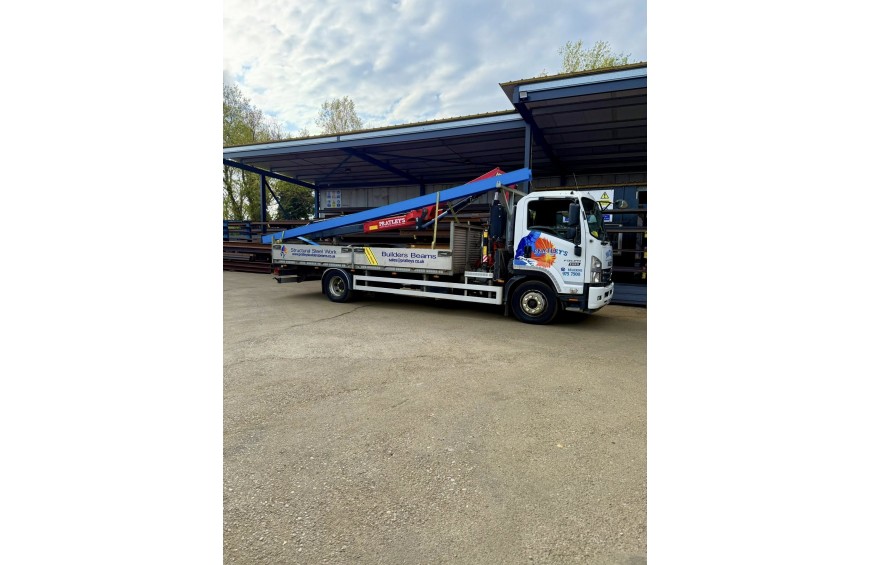
The steel beam arrives on schedule. The structural calculations are approved. Building Control has signed off the design. You've got the supporting walls ready, acrow props in place, builder standing by. Then the delivery driver looks at your terraced street, the neighbours' cars parked on both sides, the low bridge at the entrance, and says: "I can't get the lorry down here."
Your carefully planned installation day collapses. The beam sits on a lorry 200 meters away. Your builder's crew is idle. The structural opening remains unfinished. And you discover that steel beam delivery logistics—something nobody mentioned during the planning phase—has just become the critical path item delaying your entire project by a week.
This scenario repeats across UK building sites constantly. Beam specifications get exhaustive attention: correct size, adequate bearing, proper fire protection, accurate fabrication. Yet delivery logistics—how a 5-meter, 150kg steel beam actually gets from supplier to installation position in your Victorian terrace, 1960s semi, or rural conversion—receives minimal planning until the delivery day reveals problems that should have been anticipated weeks earlier.
For builders, self-builders, and developers across the UK undertaking projects involving structural steel, understanding delivery constraints and planning accordingly transforms steel delivery from potential crisis into managed logistics. Because the perfect beam delivered to the wrong location at the wrong time in the wrong manner becomes useless weight blocking your street while you scramble for alternative solutions—and every day of delay costs money in idle trades, extended scaffolding hire, and compressed project timelines.
This analysis explains the common delivery constraints affecting steel beam projects, demonstrates how delivery timing integrates with construction sequencing, quantifies the cost impact of delivery failures, and provides practical framework for planning steel deliveries that actually work for your specific site conditions.
The Delivery Constraints Nobody Warns You About
Steel suppliers quote delivery lead times (3-5 days typical for stock beams, 2-3 weeks for fabricated items), but lead time isn't the only factor determining whether delivery succeeds.
Access Constraint 1: Vehicle Size vs. Street Width
The problem: Standard steel delivery vehicles are 7.5-18 tonne rigid lorries, typically 7-9 meters long and 2.5 meters wide. Many residential streets—particularly Victorian terraces, conservation areas, and older housing estates—can't accommodate vehicles this size.
Common access failures:
Narrow streets with parked cars: A street nominally 6 meters wide becomes 3.5 meters effective width with cars parked both sides. A 2.5-meter-wide delivery lorry physically cannot pass, let alone manoeuvre for unloading.
Low bridges and height restrictions: Many urban areas have railway bridges, tree canopies, or overhead cables restricting vehicle height to 3-4 meters. Steel delivery lorries are typically 3.5-4.2 meters high, exceeding these limits.
Weight restrictions: Historic bridges, weak road surfaces, or utility infrastructure may have weight limits (often 7.5 tonnes) that delivery vehicles exceed.
Turning circles: Cul-de-sacs, tight corners, and T-junctions often lack space for large vehicles to turn. Driver may reach your street but can't position for unloading or exit afterward.
Real example: Loft conversion in Edwardian terrace, Leeds. Steel beam delivery scheduled for Tuesday 9am. Street width: 5.5 meters nominal, reduced to 3.2 meters with resident parking. Delivery lorry couldn't enter street. Beam remained on lorry. Builder's team idle. Rescheduled delivery for Saturday when resident parking restrictions allowed temporary clearance. Delay: 4 days. Cost: £800 (idle labour £400, extended scaffolding £250, rushed Saturday delivery premium £150).
Access Constraint 2: Unloading Requirements
The problem: Even when the lorry reaches your site, getting the beam off the vehicle and into position requires space, equipment, or manpower you may not have planned for.
Unloading methods and their requirements:
Hiab/crane lorry (self-unloading):
- Requires 4-6 meters clearance each side for stabilizer legs
- Needs overhead clearance for crane boom swing
- Can't operate under power lines or tree branches
- Lifting radius typically 8-12 meters maximum
- Cost premium: £150-£300 over standard delivery
Manual unloading (builder's labour):
- Requires 3-6 people depending on beam weight
- Suitable only for beams under 150kg (varies by team capability)
- Needs clear path from lorry to installation point
- Risk of injury or damage from improper handling
- Cost: Included if builder's team available, otherwise £200-£400 additional labour
Mobile crane (separate hire):
- Required for heavy beams (>300kg) or difficult access
- Needs street closure and traffic management in many cases
- Must be coordinated with beam delivery timing
- Requires stable ground for crane positioning
- Cost: £400-£800 for half-day hire plus traffic management if required
Fork lift (rare in residential):
- Useful for commercial sites with forklift access
- Requires hard standing for forklift operation
- Limited reach compared to crane
- Cost: Included on commercial sites with equipment, otherwise hire £150-£300
Common unloading failures:
Example 1: Inadequate clearance for Hiab Terraced house beam delivery, Hiab lorry specified. Driver discovered neighbour's extension 2.5 meters from road prevents stabilizer deployment. Beam couldn't be unloaded safely. Options: Manual handling (beam too heavy at 185kg), or reschedule with mobile crane. Resolution: Manual crane hired next day, £650. Delay: 1 day.
Example 2: Labour unavailable for manual unloading Builder assumed 5-meter UB could be manually handled. Beam arrived 11am. Only 2 labourers on site (rest on different job). Driver wouldn't assist (insurance liability). Beam couldn't be offloaded. Resolution: Driver returned next day when full crew available. Delivery rescheduled charge: £120. Delay: 1 day.
Access Constraint 3: Storage and Positioning Limitations
The problem: The beam must go somewhere after unloading—either directly into installation position or temporary storage until installation time. Both options have constraints.
Direct installation requirements:
- Supporting structure ready (padstones in place, openings prepared)
- Temporary supports (acrow props, needles) positioned
- Working area clear and safe
- Builder's team ready to install immediately
- Weather appropriate (some installation methods weather-sensitive)
If any of these aren't ready, the beam can't be installed immediately despite being delivered.
Temporary storage requirements:
- Level, firm ground preventing beam rolling or sinking
- Protected from theft (steel beams are valuable scrap metal)
- Not obstructing site access or work areas
- Protected from damage (paint/galvanizing scratches, bending)
- Pedestrian/vehicle safety considerations (nothing falls on beam, beam doesn't fall on anyone)
Common storage failures:
Example 1: Nowhere to put it Extension project, small urban garden site. Beam delivered before building works created space for storage. Only location: Front garden across pedestrian path. Resolution: Beam remained in front garden with temporary barriers for 4 days until rear site cleared. £80 barrier hire, £150 council temporary obstruction permission.
Example 2: Theft from insecure site Rural barn conversion. Two beams delivered and stored on site pending installation following week. Site unattended overnight. Beams stolen for scrap value (£200). Replacement cost: £1,800 (new beams) + 10-day delay waiting replacement delivery + investigation time + increased insurance premiums.
Access Constraint 4: Timing and Coordination Dependencies
The problem: Steel beam delivery must align with multiple other project activities. Mistimed delivery creates cascading delays.
Critical timing dependencies:
Before beam can be delivered:
- Building Control approval of structural design
- Supporting structure completed to receive beam
- Site access secured (scaffolding if required, barriers, permits)
- Temporary works ready (props, supports)
After beam arrives but before installation:
- Builder's team available
- Structural engineer inspection (if required)
- Unloading equipment available
- Weather suitable (if crane or Hiab involved)
After installation before continuing:
- Building Control inspection of bearing and installation
- Structural engineer certification (if required)
- Temporary supports can be removed (sometimes requires concrete curing time)
- Fire protection can be installed (if required before closing up)
Sequencing failure example:
Project: Single-storey extension requiring steel beam Planned sequence: Beam delivery Tuesday, install Tuesday, continue building Wednesday Actual sequence:
- Monday: Supporting brickwork delayed by rain (inadequate curing time)
- Tuesday: Beam delivered as scheduled
- Tuesday: Structural engineer visits, declares brickwork not ready (must cure 3 more days)
- Tuesday: Beam stored on site
- Friday: Beam installed after adequate brick curing
- Saturday: Building Control inspection (scheduled)
- Delay: 4 days from planned installation
- Costs: £400 storage/security, £300 idle labour, £180 rushed weekend Building Control inspection
The beam delivery wasn't late—but the sequence planning was inadequate, not accounting for weather-dependent prerequisite work.
The Cost Impact of Delivery Failures
When delivery logistics fail, costs accumulate beyond the obvious delivery rescheduling fee.
Direct Delivery Costs
Standard delivery (within 25 miles, accessible site):
- 1-2 beams: £60-£100
- 3-5 beams: £100-£150
- 6+ beams or complex: £150-£200
Access surcharges:
- Hiab/crane lorry: +£150-£300
- Difficult access (narrow, restricted): +£100-£200
- Timed delivery (specific window): +£50-£100
- Redelivery after failed attempt: £80-£150
Failed delivery resolution costs:
- Mobile crane hire: £400-£800
- Manual labour team (if builder unavailable): £200-£400
- Road closure/traffic management: £300-£600
- Weekend/emergency delivery: +50-100% premium
Indirect Costs (Often Larger Than Direct)
Idle labour: If builder's team assembled for installation can't proceed, you're paying for unproductive time:
- 3-person crew, 8 hours: £400-£600 wasted labour
- Knock-on effect on next job if team can't demobilize
Extended equipment hire: Scaffolding, props, barriers, skips hired for specific durations extend if beam delivery delays:
- Scaffolding: £50-£150 per week extension
- Equipment hire: £30-£80 per week
- Skip: £40-£80 per week or replacement if filled and needs swapping
Compressed timeline: Delivery delay compresses remaining project timeline, potentially forcing:
- Overtime work to recover schedule: 25-50% premium rates
- Weekend work: 50-100% premium rates
- Reduced quality from rushed work
- Stress on builder relationships
Weather exposure: Structural opening remains open longer than planned:
- Rain damage to interior: £500-£2,000+ remediation
- Heating loss: £50-£200 additional costs
- Security concerns: £100-£300 temporary boarding
Building Control timing: Many Building Control inspections must be scheduled 48 hours ahead:
- Delivery delay pushes installation back
- Installation delay pushes inspection back
- Inspection delay prevents closing up structure
- Can't proceed with subsequent trades until signed off
- Each day of delay cascades forward through all subsequent work
Total Cost Example: 5-Day Delivery Delay
Scenario: Kitchen extension steel beam, planned Tuesday delivery and installation, rescheduled to Saturday due to access failure.
Direct costs:
- Failed Tuesday delivery: Driver couldn't access, return next day attempt: £120
- Mobile crane hire Saturday (after Hiab failure): £550
- Weekend delivery premium: £150
- Direct total: £820
Indirect costs:
- Builder's team idle Tuesday (expected install day): £450
- Scaffolding 1-week extension: £120
- Compressed timeline forcing weekend work (Sunday plastering to recover schedule): £380
- Building Control inspection rescheduled (now following Tuesday): £0 (covered in fees but adds 4 more days to timeline)
- Indirect total: £950
Total cost of 5-day delivery delay: £1,770
Original beam cost: £800. Delivery delay cost more than double the beam itself.
How to Plan Steel Beam Deliveries That Actually Work
Systematic delivery planning prevents most access failures and timing issues.
Step 1: Site Access Assessment (Do This First, Not Last)
Two weeks before ordering beam, assess:
Vehicle access:
- Measure street width (actual, not nominal—account for parked cars)
- Identify height restrictions (bridges, trees, cables)
- Check weight limits (signs, or ask local council)
- Note turning restrictions (one-way, tight corners, cul-de-sacs)
- Document with photos and measurements
Unloading space:
- Measure clearance for Hiab stabilizers (6 meters minimum each side ideal)
- Identify overhead obstructions (power lines, tree branches)
- Assess ground stability (can Hiab/crane operate safely?)
- Plan alternative unloading points if primary location unsuitable
Storage location:
- Identify secure, level storage area if direct installation not possible
- Measure dimensions ensuring beam fits
- Plan protection from weather, theft, damage
- Verify storage location doesn't obstruct ongoing work
Actions if access inadequate:
If standard delivery impossible:
- Contact steel supplier explaining constraints—they'll advise delivery options
- Consider smaller/shorter beams if specification allows (easier handling)
- Price alternative unloading methods (mobile crane, manual handling team)
- Factor these costs into project budget
Step 2: Sequence Planning (Map Dependencies)
Create delivery sequence plan showing:
Prerequisites before delivery:
- [ ] Structural calculations approved
- [ ] Building Control approval obtained
- [ ] Supporting structure complete and cured (if brickwork/concrete)
- [ ] Temporary supports positioned
- [ ] Site access secured (scaffolding, barriers, permits if needed)
- [ ] Builder's team scheduled and confirmed
Day-of requirements:
- [ ] Unloading method confirmed and available
- [ ] Weather suitable (if crane/Hiab)
- [ ] Storage location prepared (if not direct install)
- [ ] Team available to receive delivery
Post-delivery actions:
- [ ] Installation completed or beam secured
- [ ] Building Control inspection scheduled (48+ hours ahead)
- [ ] Fire protection arranged (if required before closing up)
Buffer time: Build in minimum 2-3 day buffer between "prerequisites complete" and beam delivery. This allows for weather delays, curing time variations, and unexpected issues without impacting beam delivery date.
Step 3: Communication and Coordination
Three parties must coordinate:
Steel supplier:
- Provide exact delivery date/time window
- Confirm delivery vehicle type and size
- Discuss access constraints identified in assessment
- Agree delivery method (standard, Hiab, etc.)
- Provide driver contact number for delivery day
Builder:
- Confirm team availability delivery day
- Verify all prerequisites complete before confirming delivery
- Arrange unloading assistance if required
- Schedule installation immediately after delivery if possible
Building Control (if applicable):
- Schedule inspection 48+ hours ahead for post-installation inspection
- Confirm what they need to see (bearing details, fire protection, etc.)
- Verify whether installation can proceed before inspection or must wait
Critical: Every party knows the plan, their responsibilities, and contingencies if problems arise.
Step 4: Delivery Day Management
Morning of delivery:
Final checks (before lorry leaves supplier):
- Access clear (cars moved, gates open, barriers removed)
- Unloading equipment confirmed ready (crane booked, team assembled)
- Weather suitable (if crane work planned)
- Storage location prepared (if applicable)
If problems arise: Contact steel supplier immediately—don't wait for lorry to arrive and discover issues. Supplier can often adjust delivery vehicle, timing, or method if given advance notice.
During delivery:
Supervise unloading:
- Verify beam matches specification before accepting delivery
- Check for damage during transport
- Ensure safe unloading (proper equipment, trained operators)
- Position beam in storage or directly to installation location
Document:
- Photograph beam condition on delivery
- Note any issues (damage, wrong item, etc.)
- Obtain delivery confirmation/signature
After delivery:
If direct installation:
- Proceed immediately while team and equipment ready
- Document installation for Building Control inspection
If storage:
- Secure beam preventing theft
- Protect from damage and weather
- Schedule installation soonest possible (minimize storage duration)
Step 5: Contingency Planning (Hope for Best, Plan for Worst)
Pre-identify solutions for common problems:
Problem: Delivery lorry can't access street Contingency: Mobile crane hired, beam offloaded at street entrance, crane lifts to site Pre-arranged: Get mobile crane quote before delivery, have number ready to call if needed
Problem: Builder's team unavailable delivery day (emergency on other job) Contingency: Alternative manual handling team on standby, or reschedule delivery Pre-arranged: Identify labour hire company, get quote, have contingency budget
Problem: Weather unsuitable for crane work Contingency: Delay installation, secure beam in storage, reschedule Pre-arranged: Have storage area prepared in advance
Problem: Supporting structure not ready (curing time, damage, etc.) Contingency: Store beam securely, complete supporting structure, install when ready Pre-arranged: Build extra buffer time into sequence preventing this scenario
Special Case: Difficult Access Solutions
Some sites have inherent access constraints requiring creative solutions.
Pedestrian Access Only (No Vehicle Access)
Scenarios:
- Pedestrianized streets
- Rear gardens accessible only through house
- Upper floor installations with no external access
Solutions:
Beam delivery to nearest vehicle access point + manual carry:
- Feasible only for lighter beams (<100kg)
- Requires team of 4-6 people
- Time-consuming (1-2 hours for difficult carries)
- Cost: £200-£400 labour
Crane lift over buildings:
- Mobile crane positioned on accessible street
- Beam lifted over building to rear garden/site
- Requires crane with adequate reach and capacity
- Cost: £600-£1,200 depending on crane size and duration
Sectional beams (if structural design allows):
- Longer beam delivered as shorter sections
- Sections connected on-site with bolted connections
- Easier manual handling of smaller pieces
- Requires engineer approval of sectional design
- Cost premium: £200-£400 for sectional fabrication
Real example: Victorian terrace mid-row, rear kitchen extension. Pedestrian access only (through house). 4-meter beam required. Solution: Crane lift over roof to rear garden. Crane positioned in parallel street, beam lifted 12 meters over building. Cost: £750. Alternative: Sectional 2× 2-meter beams manually carried through house. Cost: £350 (sectional fabrication £250, carry labour £100). Client chose manual carry for budget reasons.
Height-Restricted Access
Scenarios:
- Low railway bridges
- Tree-lined streets
- Listed buildings with protection restrictions
Solutions:
Lower-height delivery vehicle:
- Smaller vehicle (7.5 tonne) may clear restrictions larger ones can't
- Reduces payload capacity (fewer/smaller beams per delivery)
- May cost more per beam due to multiple trips
- Cost impact: +£50-£100 per delivery
Alternative route:
- Longer route avoiding height restriction
- May add significant distance and time
- Check with supplier whether alternative route feasible
- Cost impact: +£30-£80 depending on distance
Offload before restriction, transfer to smaller vehicle:
- Beam delivered to point before restriction
- Transferred to pickup truck, van, or trailer
- Transported to site manually
- Cost: £150-£300 for transfer and secondary transport
Urban Congestion and Parking Restrictions
Scenarios:
- London and major cities
- Resident parking permit zones
- Loading restrictions
- Narrow Victorian terraces
Solutions:
Parking suspension:
- Apply to local council for temporary parking suspension
- Creates clearance for delivery vehicle
- Requires 5-10 working days advance notice typically
- Cost: £100-£300 depending on council and duration
Weekend/evening delivery:
- Deliver when resident parking less dense
- May require premium delivery charges
- Coordinate with council if restrictions still apply outside peak hours
- Cost premium: +£100-£200 for weekend/evening
Traffic management:
- Professional traffic management for difficult deliveries
- Road closure or temporary access
- Required for some council areas
- Cost: £300-£600
The Pratley's Approach: Delivery Planning Support
We've delivered thousands of steel beams across residential, commercial, and industrial sites. We've seen every access problem and sequencing failure. That experience informs how we work with customers.
Our delivery planning process:
1. Access discussion during quotation: We ask about site access before quoting, not after. This ensures we recommend appropriate delivery method and price correctly.
2. Site visit for complex deliveries: For difficult sites (tight access, complex lifts, challenging locations), we visit beforehand assessing options and planning approach.
3. Delivery method recommendations: We advise on unloading method based on beam weight, access, and site conditions. If standard delivery won't work, we explain why and suggest alternatives.
4. Flexible scheduling: We work around your project sequence, not rigid delivery schedules. If you need delivery Tuesday because Building Control inspects Wednesday, we accommodate that.
5. Coordination support: We provide delivery driver contact numbers, adjust timing on delivery day if site conditions change, and problem-solve if unexpected issues arise.
6. Realistic expectations: We won't promise delivery we can't achieve. If your access is problematic, we'll tell you upfront and help you plan appropriate solutions—not discover problems on delivery day.
Conclusion: Delivery Logistics Are Part of Steel Beam Planning
The perfect steel beam delivered at the wrong time, to the wrong location, or via the wrong method becomes an expensive problem instead of a construction solution. Yet delivery logistics receive minimal planning attention compared to structural design, beam selection, and specification details.
For builders and self-builders across the UK, treating delivery as a critical planning element—assessing access constraints, mapping timing dependencies, coordinating with all parties, and preparing contingencies—prevents the delivery day disasters that delay projects and multiply costs.
The good news: most delivery problems are preventable through advance planning. The bad news: most people don't realize delivery needs planning until the lorry can't access their street.
Pratley's Builders Beams helps customers navigate delivery planning through honest access assessment, appropriate delivery method recommendations, and coordination support ensuring beams arrive when and where needed via methods that actually work.
Your steel beam project deserves the same attention to delivery logistics as to structural adequacy. Both determine whether installation succeeds or fails.
Contact Pratley's Builders Beams at [contact details] to discuss your steel beam requirements including delivery planning. We'll help you plan deliveries that work for your specific site—before problems arise, not after.
Because the right beam delivered wrong still delays your build.

Submit comment Cancel Reply